Thursday, October 26, 2023

From subversive to the new normal: 25 years of Open Access

As part of Open Access Week, Simon Linacre looks at 25 years of Open Access through the lens of Dimensions to help us better understand the growth of OA over a quarter of a century.

How old is Open Access? In some ways it is as old as research itself, as at least some results have always been shared publicly. However, since the first journals were published in 1665, accessibility has been an issue, with distribution of paper journals limiting potential readership. When the internet came along, it lowered the barriers to access considerably and opened up the pathway towards Open Access. But that process has been a gradual one.

As a tutor for ALPSP and course leader for some of its industry training modules, I have to be wary of approaching topics such as Open Access. Not because it is especially contentious or difficult, but because as someone who has been involved in scholarly communications for over 20 years, it still feels relatively ‘new’ to me, whereas for most attendees it is simply part of the modern furniture of publishing.

However, as Churchill once said, the longer you can look back, the farther you can look forward, so this year’s OA Week seems as good a time as any to review how its development has progressed over the years. Luckily, in Dimensions we have a tool which can look at millions of articles, both OA and closed access, published over the last quarter of a century.
Back story

Pointing to a specific time to say ‘this is when OA started’ is difficult, as experiments with OA publishing arrived with the internet in the late 1980s and early 1990s. Perhaps the first rallying cry in support of OA came in 1994 when Stevan Harnad published his Subversive Proposal. However, in 1998 several things happened which started to shape the way OA would develop, including the setting up of a number of support networks for authors to advise how to follow the OA path, as well as the founding of the Public Knowledge Project (PKP). New tools and services introduced then started to re-engineer how academic publishing operated, which were only amplified by the global adoption of the internet.

Such developments were followed in subsequent years by major declarations from academics and institutions in support of OA, mainly from European cities starting with ‘B’ – both Budapest and Berlin were the basis for such declarations that propelled Open Access forward and firmly onto the agendas of all stakeholders. Some countries and academic cultures adopted OA principles quickly such as Brazil, however it wasn’t until the 2010s that we started to see significant policy changes in Global North countries such as the US and the UK. 

These OA policies have now not only become commonplace, but have strengthened with initiatives like Plan_S in Europe and the OSTP (or Nelson) Memo in the US driving forward the transition towards fuller OA. It feels like the rate of change has increased in the last few years, but is this true and what does the picture look like globally?

Ch-ch-ch-changes

As we can see in the chart below using Dimensions, growth in OA research article publications has been relatively steady over the last 25 years, with a steeper rise in recent years followed by a shallower rise in 2022. This can perhaps be attributed in part to the introduction of Plan_S in 2018 and the introduction of funder mandates, but also the impact of the Covid-19 epidemic which drove OA publications upwards in 2020 and 2021, not least through the avenue of OA preprints.
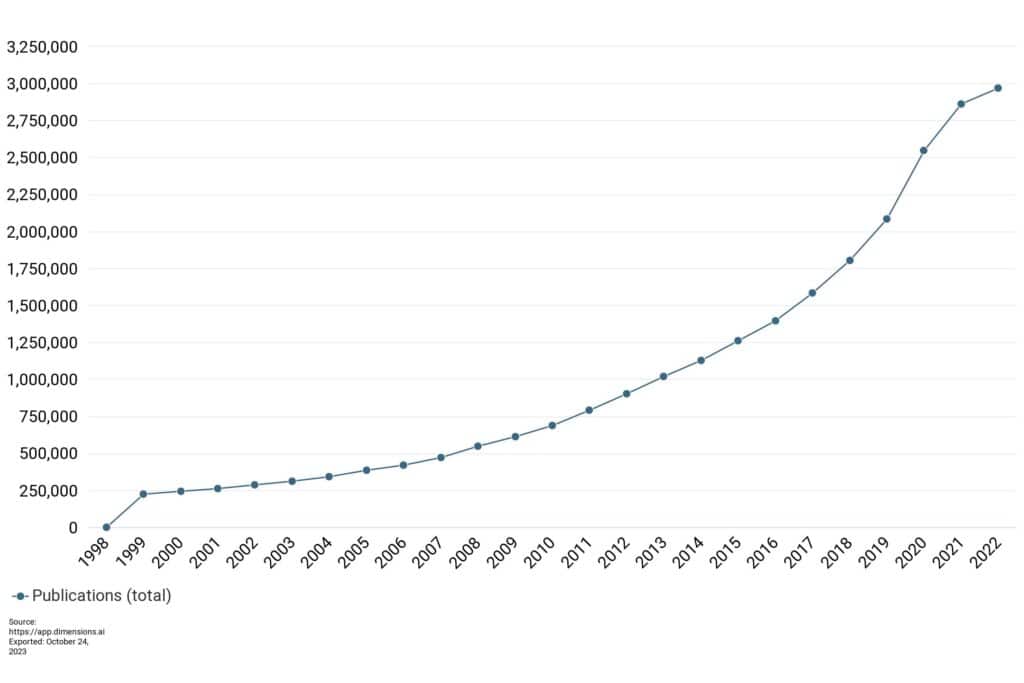
Figure 1: Total Open Access research articles by year. Source: Dimensions.

However, appearances can be deceptive. While the chart may seem to plot a steady increase, the 12-fold rise over 25 years is significantly faster than the four-fold rise seen from all research articles, with all OA articles now making up well over half of all articles.

Looking more closely at the type of OA article recorded on Dimensions, if we look just at Gold OA research articles over time (ie. those published in journals, typically after payment of an article processing charge (APC)), we see a similar development, albeit with a slower take off and steeper rise in recent times.
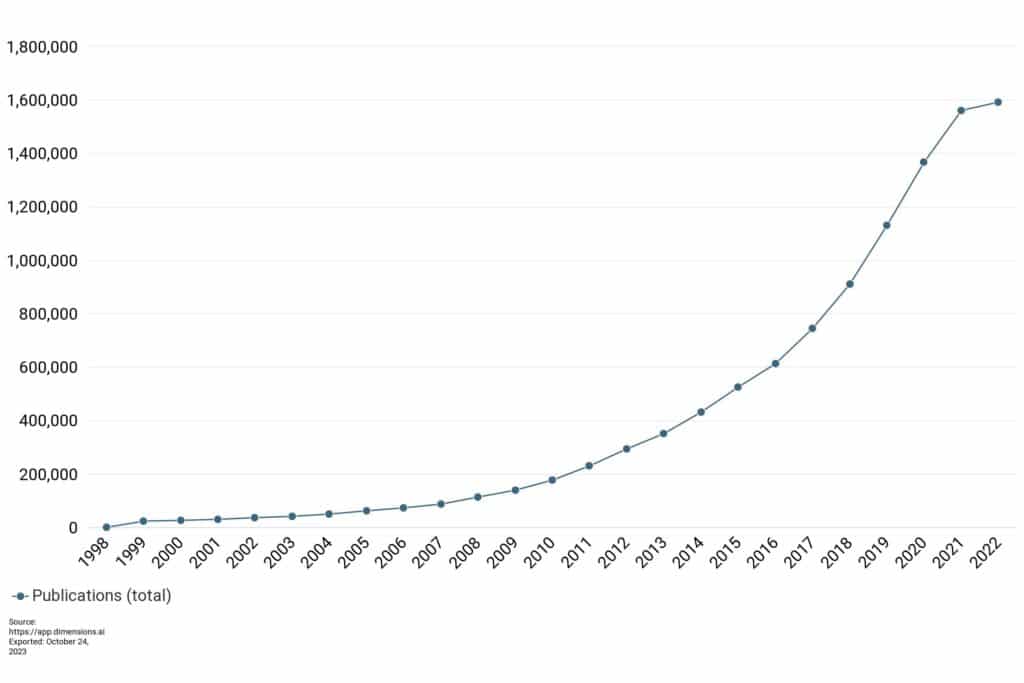
Figure 2: Gold Open Access research articles by year. Source: Dimensions.

However, if we look at Green OA research articles made available over the same period, we see a much more complex development, with higher rates of adoption in the early years of OA following a shallower trajectory before a huge spike in 2020, driven by the aforementioned pandemic. 
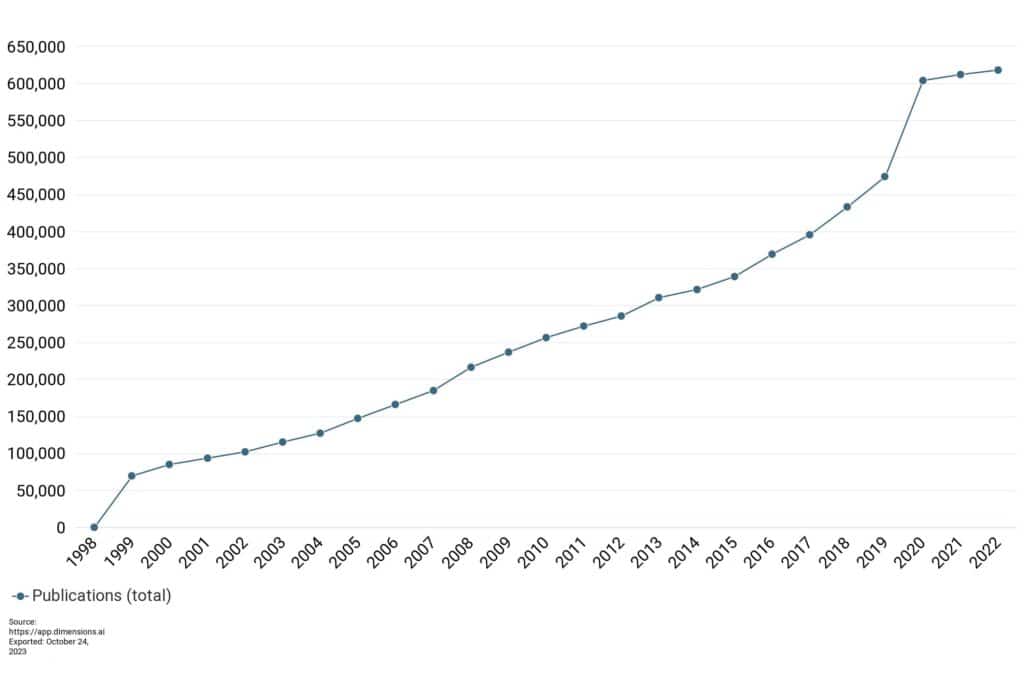
Figure 3: Green Open Access research articles by year. Source: Dimensions.

We can see the change more markedly below if we look at all publications (as opposed to just research articles) in more recent years, with Green and Gold running neck-and-neck until they diverged over the last decade or so. For many early proponents of Green Open Access who were opposed to the high profit margins enjoyed by many, this highlights how Green OA has failed in comparison to Gold Open Access. 
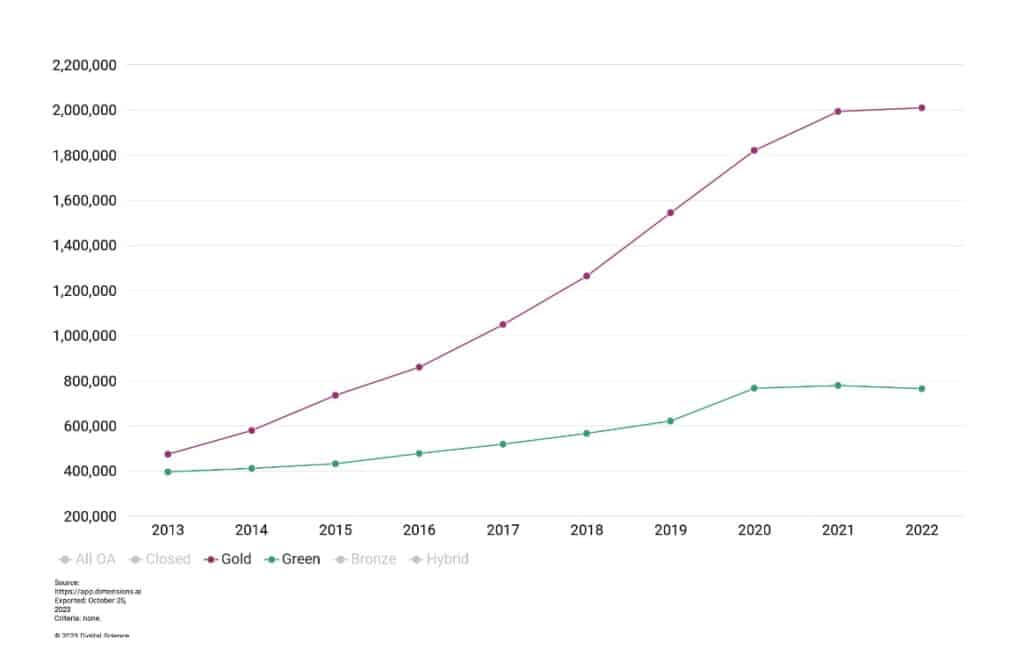
Figure 4: Gold vs Green Open Access – all publications. Source: Dimensions.

Looking ahead

What do these data tell us about the next 25 years? Perhaps the key takeaway is that shifts in behaviour of authors can be caused by concerted policymaking. Indeed, even the commitment to future mandates can be a catalyst for change as publishers prepare the groundwork quickly for upcoming changes. However, the biggest single shift towards OA happened during something wholly unforeseen (the pandemic), and as geopolitics is in its most volatile state in the whole 25 year period, maybe the biggest changes in OA are just round the corner. 

Request a demo or quote
Simon Linacre

About the Author

Simon Linacre, Head of Content, Brand & Press | Digital Science

Simon has 20 years’ experience in scholarly communications. He has lectured and published on the topics of bibliometrics, publication ethics and research impact, and has recently authored a book on predatory publishing. Simon is also a COPE Trustee and ALPSP tutor, and holds Masters degrees in Philosophy and International Business.

The post From subversive to the new normal: 25 years of Open Access appeared first on Digital Science.


from Digital Science https://ift.tt/KqVeZdk

Monday, October 23, 2023

New path opens up support for humanities in OA publishing

Open Access monographs concept graphic

Can a new Open Access collection help overcome the challenges facing monographs? In the latest in our OA books series to coincide with OA Week, guest author Sarah McKee explains the case for Path to Open.

Path to Open, a new open access pilot for book publications in the humanities and social sciences, has launched its collection this month, with 100 titles covering 36 disciplines from more than 30 university presses. This represents a major and much-needed step forward for Open Access publishing in general, and for the humanities specifically.

The pilot began in January as a collaboration among university presses, libraries, and scholars. It has emerged at a moment when students, administrators, and political leaders in the United States openly doubt the value and relevance of the humanities.1 Their questions stem at least in part from a widespread misunderstanding of the term “humanities”, the disciplines it includes, and the inquiries posed by its scholars.

Such misunderstandings are perhaps not surprising. Scholarly books, often referred to as monographs, have served for decades as the primary mode for sharing research findings in the humanities but are currently distributed in ways that privilege a narrow audience.2

University presses – long-time champions and producers of monographs – have lost crucial institutional support, leaving many in difficult financial circumstances. The resulting high prices for monographs often exclude scholars, students, and others without affiliation at well-funded research libraries, and the problems multiply for those outside the established book distribution networks of North America and Western Europe.

Compared with STEM disciplines, the humanities receive little public funding for research and publication, making the move to open access much more challenging.

A commitment to finding new ways of sharing monographs drives the development of Path to Open. As Charles Watkinson and Melissa Pitts have noted, academic stakeholders “have long seen the value in investing significant resources to sustain science infrastructures that contribute to a common good. It is essential to their mission that they collaborate and invest with that same care in the crucial infrastructure for humanities research embodied by the network of university presses”.

Creating multimodal digital monographs, for many authors, is about making the humanities relevant and accessible to wider audiences who can both benefit from and contribute to scholarly production in tangible, meaningful ways. At the same, open access publication provides not only wide distribution but also a mechanism by which digital scholarship may undergo formal development and evaluation with a university press. But the ability to create open multimodal publications is itself fraught with inequity, requiring collaboration partners, expertise, and funding not yet widely available to all scholars or to their publishers.

Path to Open seeks to create an infrastructure that allows more publishers – especially small and mid-sized university presses – to experiment with open access distribution while also boosting the circulation of research from a community of diverse humanities scholars. The initiative is distinctive among open access models because, as John Sherer explains, it proposes a “compromise between the legacy model of university press publishing and a fully funded OA model”.

“A commitment to finding new ways of sharing monographs drives the development of Path to Open.”

Sarah McKee

Path to Open operates as a library subscription – administered exclusively by JSTOR – that guarantees payments of at least US$5,000 per title to participating publishers, to help offset potential losses in digital sales. With the launch of the online collection this month, presses also have the option to sell print editions of all books, as well as direct-to-consumer e-books.

A sliding scale for subscription costs provides more equitable access to libraries of varying sizes and budgets, and more than 60 libraries have joined to date, including members of the Big Ten Academic Alliance. The initial 100 titles transition to full open access by 2026, and new titles will be added in each of the following three pilot years to reach an expected total of 1,000 open access books by 2029.

The model aims to reduce financial risk for presses while also acknowledging lingering hesitation about open access publication within the humanities community. As John Sherer finds, many authors fear that “an OA monograph would be viewed less favorably than a traditional print monograph would in the tenure and promotion review process”.

Monographs take years to produce, and they function quite differently from journal articles in the scholarly ecosystem. Many of these books maintain their relevance for years, even decades, past the original publication date. Over the life of the pilot, JSTOR will track various usage metrics for all titles in the collection both before and after the transition to open access.

The partnership with JSTOR provides a unique opportunity to gather data in a controlled environment, with hopes of gaining much-needed insights into the behavior of readers, the effect of open access on print sales, and the timing of peak impact for monographs in various disciplines. Understanding such issues is key to strengthening the vital infrastructure that supports humanities research and to ensure its place alongside open STEM scholarship.

The American Council of Learned Societies (ACLS) has committed to providing a robust and transparent structure for community engagement with Path to Open. In consultation with the Educopia Institute, ACLS is developing a forum to encourage dialogue among key stakeholders, including publishers, libraries, scholars, and academic administrators. Inviting scholars into these conversations is critical for a shared understanding of how open access affects humanistic disciplines, institutions of higher education, students, and individual academic careers.

Our hope at ACLS is that an inclusive dialogue about Path to Open will generate greater understanding of the stakes for various constituents within the humanities community, and guide decisions for the future of scholarly publishing in sustainable and equitable ways.


1 Nathan Heller, “The End of the English Major,” The New Yorker, February 27, 2023.

2 See also Michael A. Elliott, “The Future of the Monograph in the Digital Era,” The Journal of Electronic Publishing 18, no. 4 (fall 2015).

About the Author

Sarah McKee

Sarah McKee, Project Manager, Publishing Initiatives | American Council of Learned Societies (ACLS)

As Project Manager for Publishing Initiatives, Sarah McKee works to support a healthy ecosystem for the creation and dissemination of humanistic scholarship across disciplines and institutions. She previously administered Digital Publishing in the Humanities, sponsored by the Mellon Foundation and based at Emory University’s Fox Center for Humanistic Inquiry, and served as managing editor of the born-digital New Georgia Encyclopedia at the University of Georgia Press. She is an advisory board member for the Next Generation Library Project and is a co-author of the report Multimodal Digital Monographs: Content, Collaboration, Community (2022).

The post New path opens up support for humanities in OA publishing appeared first on Digital Science.


from Digital Science https://ift.tt/fTLZA6M

Tuesday, September 12, 2023

Dimensions shines a spotlight on research security

Dimensions Research Security is the new tool to assess and mitigate risk, and assist with compliance


Digital Science’s flagship product Dimensions has announced a new solution for research institutions and industry, helping to identify risks associated with government research security requirements. Why is the Dimensions Research Security app the right choice for your research operations?

Universities and industry involved in research and development are no strangers to the need to protect intellectual property and mitigate against risk. Nevertheless, organizations around the world – from the FBI in the United States to Universities UK – are increasingly calling for these risks to be taken more seriously.

Inevitably, additional government regulations and recommendations have followed, requiring research institutions – and individual researchers who receive government funding – to demonstrate compliance within their local jurisdictions. Failing to do so can result in penalties and loss of reputation, as well as the impact on research, and economies that rely on that research.

The complexity of these issues combined with the vast networks of research globally means that institutions often can’t “go it alone” – they need something to shine a stronger, brighter spotlight on research security compliance, and to provide the right information to assist in making the best decisions.

Dimensions – among the world’s largest linked research databases – is perfectly placed to be a beacon of light on these issues.

The new Dimensions Research Security app

The Dimensions Research Security app includes a visual dashboard that enables research organizations to obtain information quickly and easily.

Reviewing research collaborations for compliance? Dimensions Research Security enables you to thoroughly and efficiently conduct due diligence on potential research collaborations, helping you to save on time and resources.

With Dimensions Research Security, you can:

  • Efficiently verify disclosures
  • See all research collaborations – via grant funding information or co-authorship on publications, in patents or in clinical trials
  • Surface multiple affiliations for individual researchers
  • Screen for restricted entities or individuals
  • Pinpoint countries of interest
  • Uncover direct and indirect funding sources
  • Reveal undisclosed collaborations or international funding sources that could put grant applications at risk.

Research organizations are then able to assess and prioritize potential risks, with the power of world-leading information at their fingertips.

Find out more about the new Dimensions Research Security app at the Dimensions blog site, or ask for a demonstration today.


About Dimensions

Part of Digital Science, Dimensions is among the world’s largest linked research database and data infrastructure provider, re-imagining research discovery with access to grants, publications, clinical trials, patents and policy documents all in one place. www.dimensions.ai. Follow @DSDimensions on X (Twitter) and LinkedIn.

About the Author

David Ellis 2023
David Ellis

David Ellis, Press, PR and Social Manager | Digital Science

David has 30 years’ experience in media and communications. With a background in broadcast journalism, his career focus has been in research communication – including science, health science and medicine – spanning 25 years of service in the university sector. His experience also includes both internal and external communications in the health and manufacturing sectors.

The post Dimensions shines a spotlight on research security appeared first on Digital Science.


from Digital Science https://ift.tt/NT05wUQ

Friday, September 8, 2023

What are YOU reading? Top recommendations and reviews from Digital Science

Friday 8 September is UNESCO International Literacy Day, and to celebrate the world of books, colleagues at Digital Science have shared their recommendations and reviews of books that have interested and inspired them over summer.

Heather Luciano

Currently reading The Earth Transformed by Peter Frankopan, which takes a sweeping look at the ways humanity and climate change have impacted each other (leading to development and demise) over time.

—Heather Luciano

Dr Leslie McIntosh
Leslie McIntosh

Review: Strolling through St Pancras Station, London waiting on my train, I popped into a bookshop looking for a specific title. Unsurprisingly, they didn’t have the obscure book I wanted, so I perused a bit more. Two addictions consume my life: tea and books. If I go into either type of store, I never walk out empty handed. I left with Freedom to Think: Protecting a Fundamental Human Right in the Digital Age by Susie Alegre.

“Human rights law guarantees freedom of thought, conscience, belief and opinion….” This book lays out the laws to the educated reader giving us the words to understand and speak about our most sacred freedom. Alegre illuminates the art of mind control by what is and is not done to people. Like learning to paint – you must think as much about what is there as what is not – the negative space created to poignantly focus the observer. Through human-developed algorithms and strategize investments with little legal oversight, humanity is threatened as much by what we see as what we are excluded from seeing. “Freedom of thought is about the space to think before you share.” We need that space. But no one will give it to us; it must be claimed for ourselves. Give this book a think.

—Leslie McIntosh

Sara Gonzalez

If you’re looking for creepy but not gruesome, I recommend T. Kingfisher’s The Hollow Places. I also just finished her book A House with Good Bones but didn’t find it as hauntingly bizarre.

—Sara Gonzalez

Sasha Gӧbbels

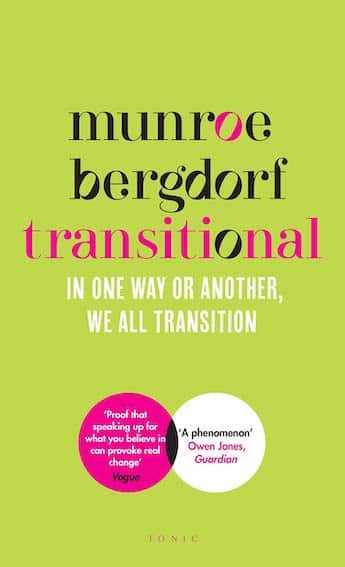
I read Munroe Bergdorf’s autobiography Transitional. Bergdorf is one of the very few transgender PoC fashion models (among many other things she does). She has been the campaign face for L’Oreal (before they sacked her for political posts on Instagram in 2017). The book is less about being transgender and more about what she learned on her journey. About racism, equality, being in the spotlight of public attention and finally purpose in life: “Nowhere feels like home when it’s you that you’re running from.”

—Sasha Gӧbbels

Carola Blackwood

Review: Magpie Murders by Anthony Horowitz.

Great book for puzzle and mystery fans, this is a compelling story within a story. An editor receives a famous author’s latest manuscript and she expects all will be the same as his previous award winning books. But all is not the same in the book, nor in her life, after receiving the manuscript minus the last chapter. What happened to the last chapter? The book weaves in and out of the first story and the ‘book within the book’, and although the story in the manuscript is a traditional British Manor Murder Mystery, reminiscent of Agatha Christie and Sherlock Holmes, the detective Atticus Pünd solves mysteries in his own unique way.

This is a clever book with great twists and a beautiful voice. Best of all, the ending is completely unexpected. Great fun.

—Carola Blackwood

Emily Alagha

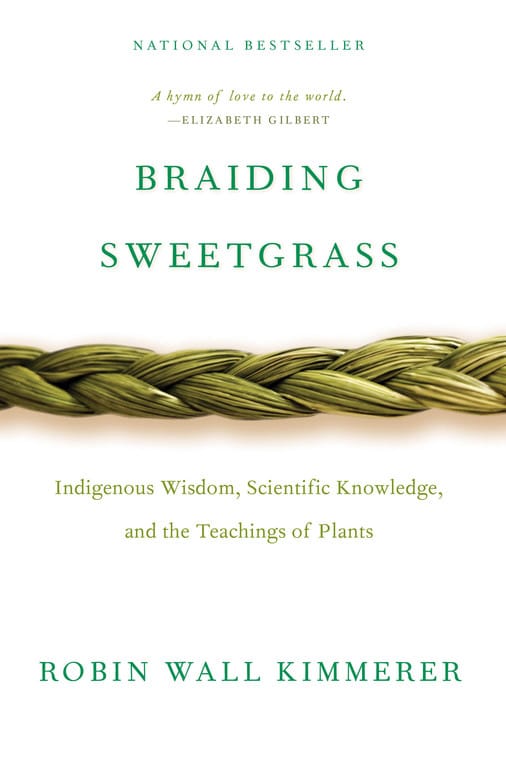
Currently reading Braiding Sweetgrass. Beautifully written nonfiction which explores the intersections of Indigenous knowledge and plant science. Lots of food for thought for those interested in the culture of science!

Also recommend The Priory of the Orange Tree if you like things with dragons.

—Emily Alagha

Adrien De Sutter

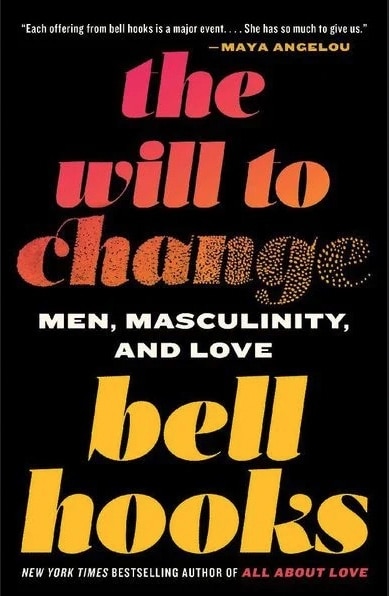
I recently finished bell hooks’ The Will to Change, which I recommend to anybody wanting a more complete critical approach to understanding patriarchy and its effects. That it is a book written with love and care, and is in hooks’ unique and inviting colloquial style, makes her argument all the more impactful: though men have clear rewards in patriarchy, we are all ultimately its victims and must attend to the role we all play in perpetuating and sustaining patriarchal culture.

—Adrien De Sutter

Simon Linacre
Simon Linacre

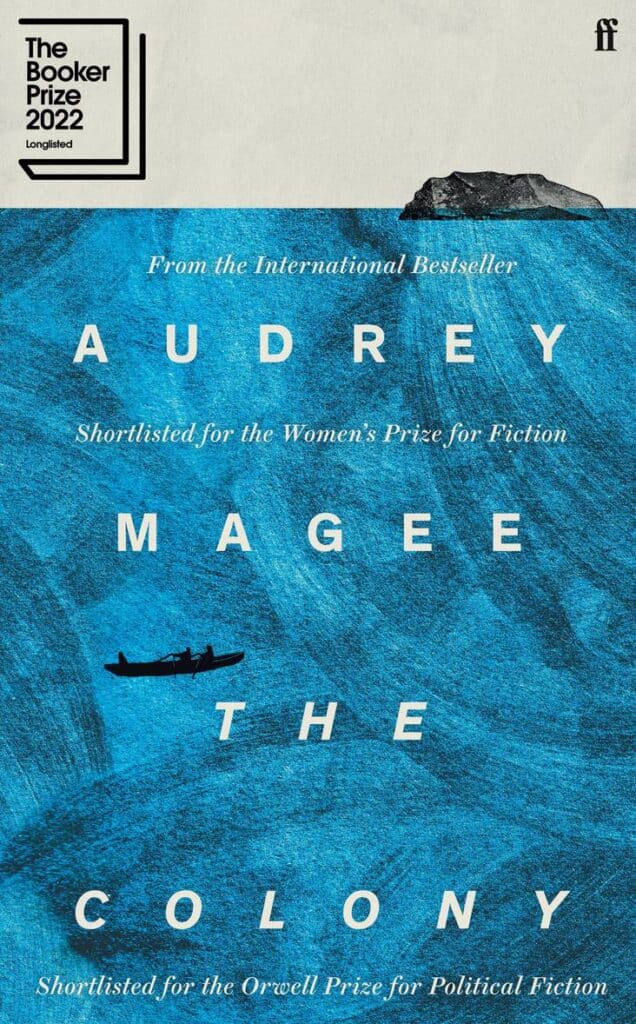
Review: The Colony by Audrey Magee.

I was fascinated by the premise of this book, which on the one hand was a slightly odd tale of two outsiders spending the summer on a remote Irish island, but was also intertwined with the Troubles in Northern Ireland in the 1970s as well as offering an allegory of the impact of colonial rule. Not only does the author create fascinating narratives on all these levels, she also manages to build tension through a slow burn of a plot, portraying very real characters as well as a wicked dark humour. All this combined to offer a very rich reading experience with a heartbreaking ending to boot. Very highly recommended.

—Simon Linacre

Jamie MacIsaac

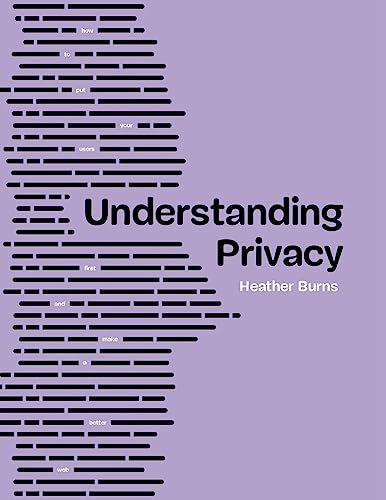
Currently in the middle of two books – first is Understanding Privacy by Heather Burns. I’m “In the middle of” because the dead tree edition hasn’t arrived yet, but can’t help but read ahead in the ePub. Picked this up ‘cos I’ve been following Heather’s engaging posts on the birdsite. Nearly finished The Malevolent Seven by Sebastien de Castell ‘cos I’m a sucker for catchy titles – it’s (absolutely not!) beardy wizard fantasy stuff, but needed something to while away the hours as a recent guest at the Royal Infirmary. A fun read!

—Jamie MacIsaac

Lisa Curtin

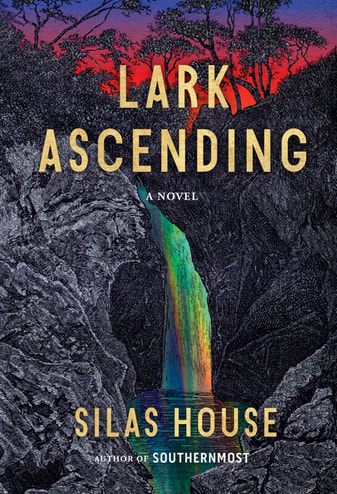
Review: In Lark Ascending, Silas House strikes a poignant balance between hope and grief over the state of the world (present and future). It’s a dystopian tale but not a sci-fi one, featuring a heartbreaking queer love story and one of the best dog characters ever written. Left me with lots of feelings and lots to think about – as have House’s other novels. I‘ve been reading a lot of what might loosely fall into the genre of ‘climate fiction’ over the past few years, and this one really stands out.

—Lisa Curtin

Tyler Ruse

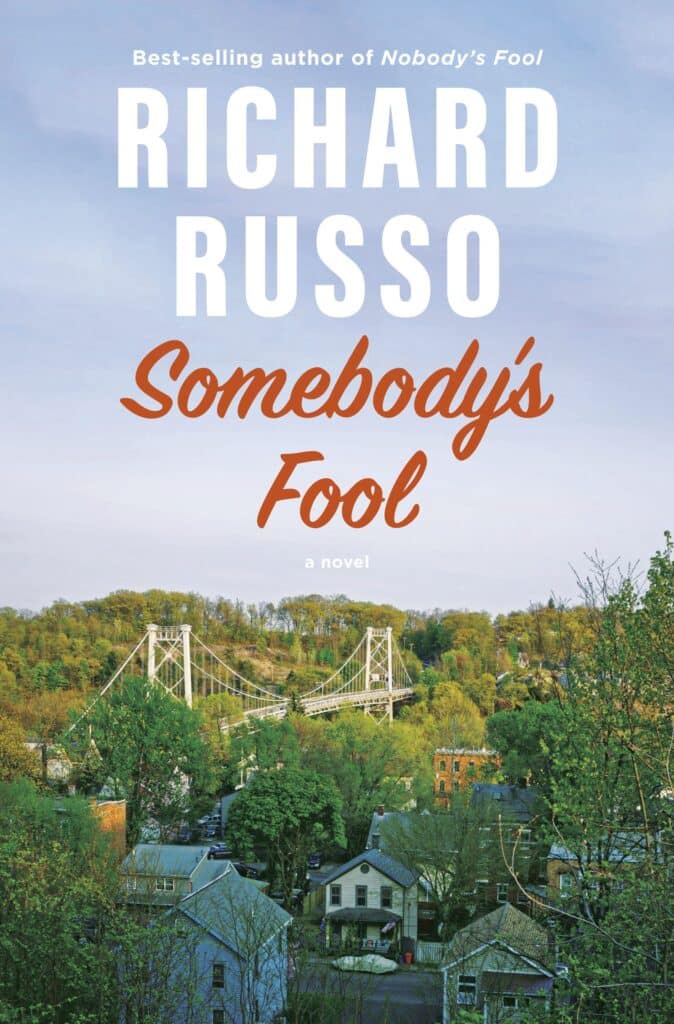
On my list (for a very summer-fiction entry) is the recently published Somebody’s Fool by Richard Russo.

—Tyler Ruse

Niall Cunniffe

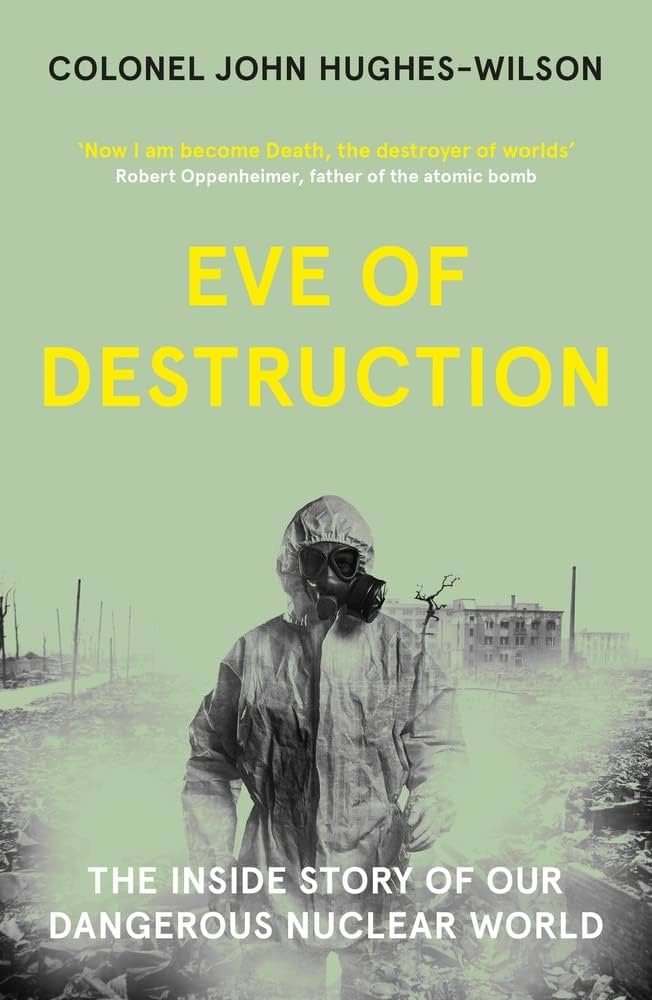
Having also watched (and survived) Oppenheimer, Eve of Destruction is on my list. Might be grim summer reading though!

—Niall Cunniffe

The post What are YOU reading? Top recommendations and reviews from Digital Science appeared first on Digital Science.


from Digital Science https://ift.tt/FQpNRsr

Friday, August 11, 2023

Has Prosecco research lost its fizz?

There are many reasons to celebrate International Prosecco Day – but are researchers also raising a glass to one of Italy’s finest exports? Simon Linacre offers a quick taste of what we can learn from recent vintages of research outputs.

For many of us, prosecco seems to have become the sine qua non of any gathering, combining as it does the popping cork, light fizz and often considerable price benefit compared to champagne. Celebrated on 13 August each year, it offers a chance for prosecco producers to market their wines, and for the rest of us to, well, enjoy them!

But aside from the marketing fluff, what’s going on academically with prosecco? Dimensions and Altmetric – as well as being fantastically powerful tools to aid deep investigation of research topics – can also offer insight into almost any field of study. So, what can we glean from recent studies on prosecco?

Sparkling wine glasses raised. Stock image.

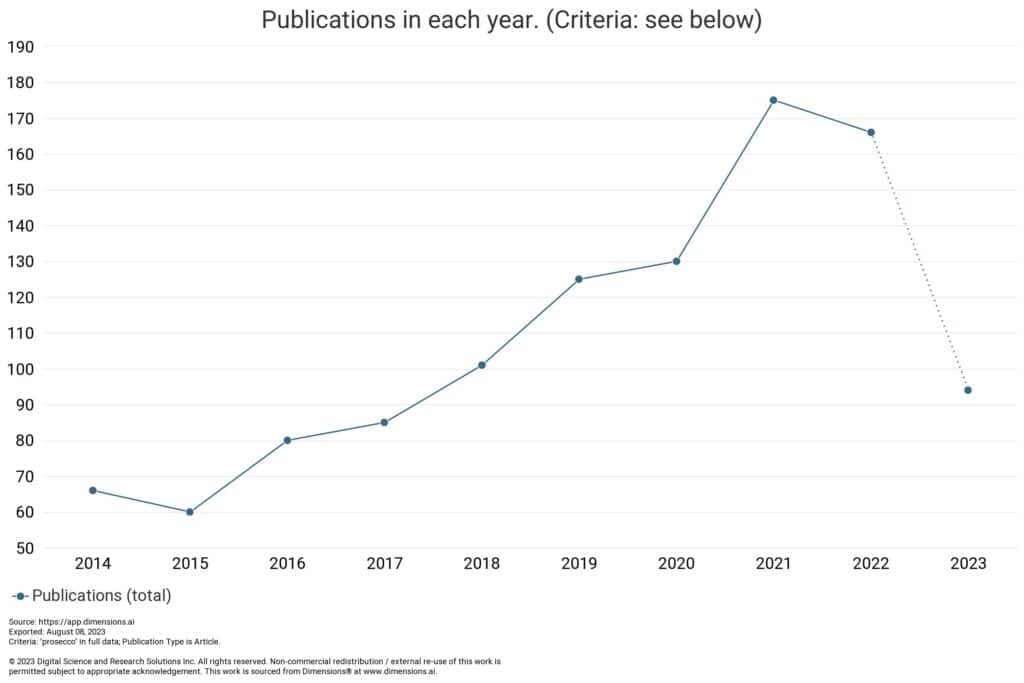
In Figure 1, we can see that the number of articles that mention ‘prosecco’ has steadily grown in the last decade, with a pronounced increase in 2021. However, this seemed to tail off in 2022, so perhaps interest in the topic has started to wane. This almost exactly mirrors global sales of prosecco and Italian wine in general, which have tailed off in 2022 after performing well during the pandemic.

Figure 1: Publications about prosecco by year. Source: Dimensions.

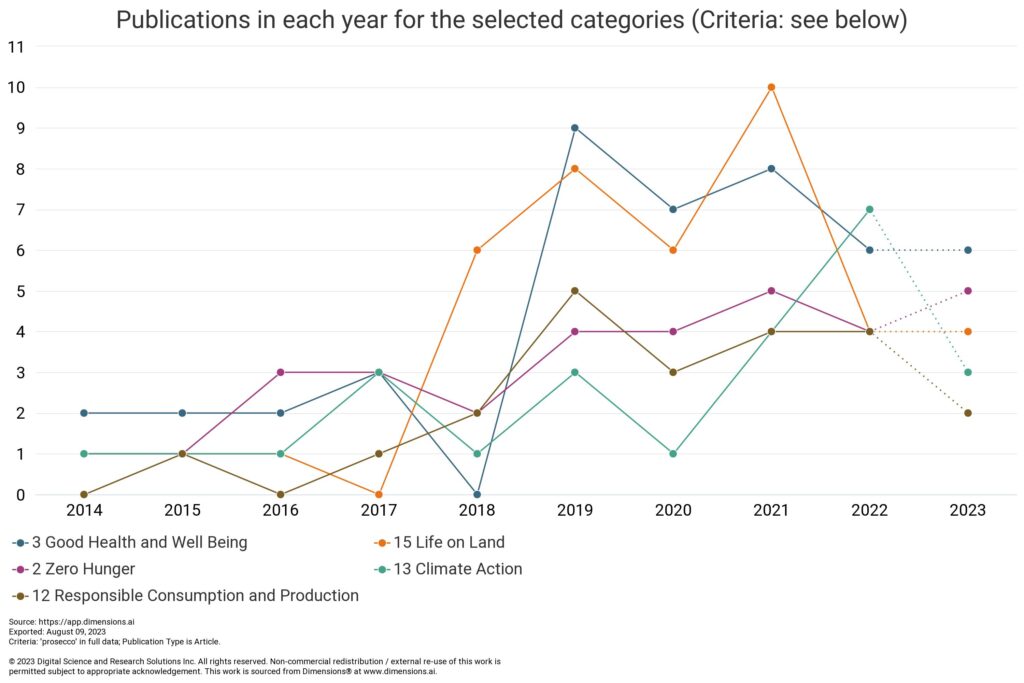
However, if we break it down by the number of articles published by Sustainable Development Goals – one of the most useful ways of delineating research on Dimensions – we can see that while there has been a drop in research related to Good Health and Well Being (SDG #3) and Life on Land (#15), there has been a marked increase in research on prosecco related to SDG #13, namely Climate Action. This perhaps reflects overall increased focus in this topic, particularly when related to food production where climate change is impacting on vines and crops, and any ability to meet increased demands.

Figure 2: Number of publications about prosecco that relate to the Sustainable Development Goals (SDGs). Source: Dimensions.

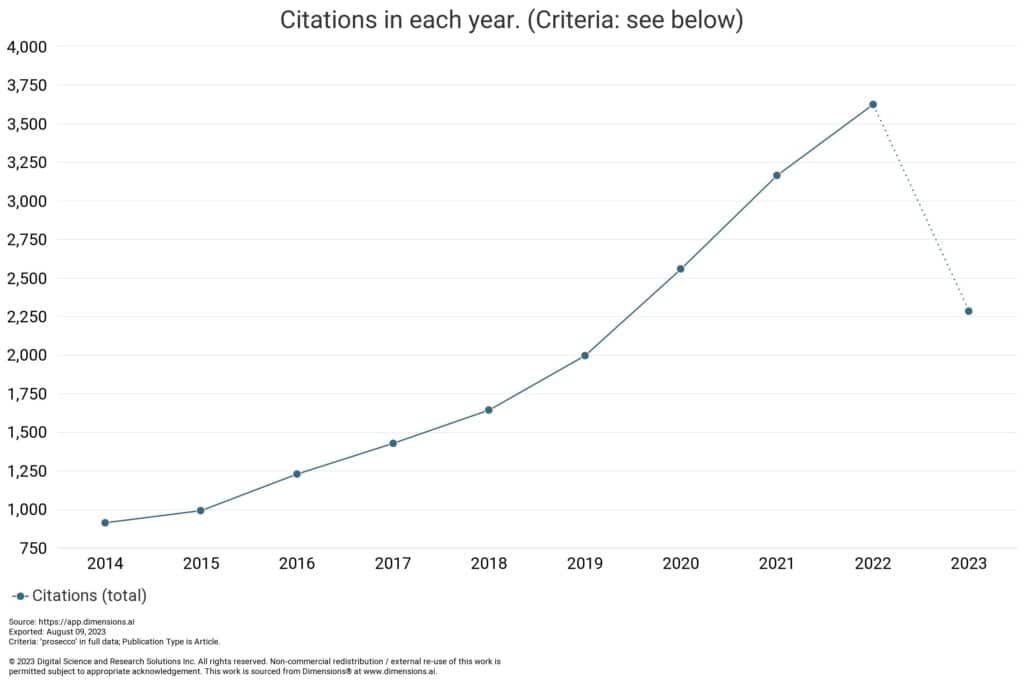
Certainly the reporting on prosecco-related research is maintaining its upwards trajectory, as we can see from Figure 3, which shows a steady increase in citations of research in this area. As there is a lag between citations and publications, we may see this drop away in future if the decline in research on prosecco remains on a downward trend.

Figure 3: Citations. Source: Dimensions.

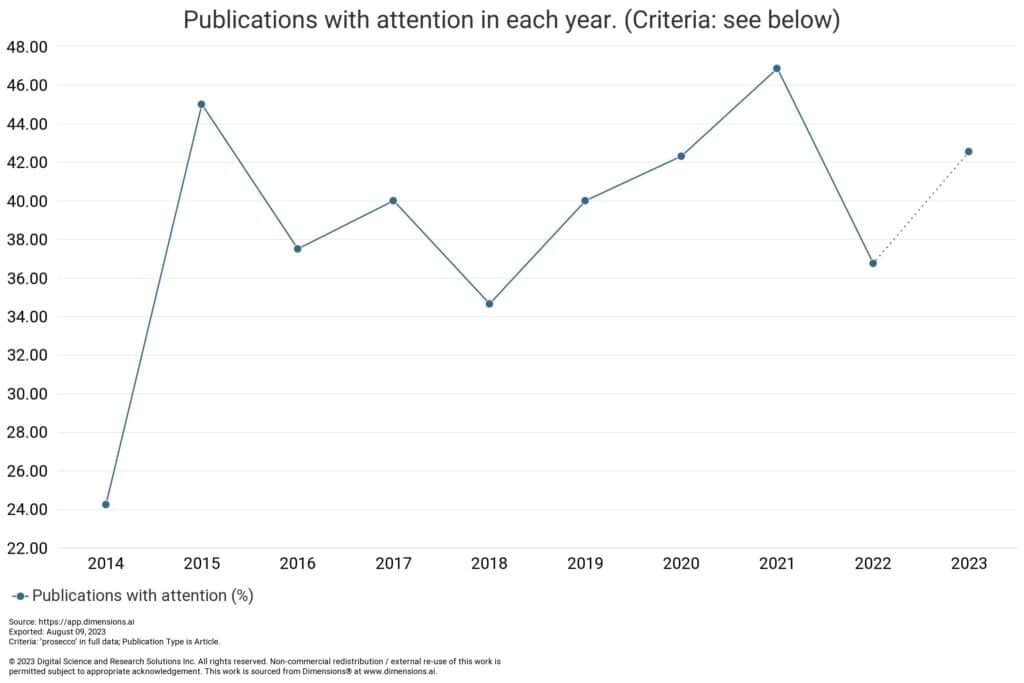
When we look at the influence of the research outside academia, we may have expected a similar continual rise, however data from Altmetric shows if anything a steeper decline than we saw in research output. This could be explained in part by the much shorter lead time that digital influence exhibits compared to citations, but it could also be a strong indicator that prosecco research has had its place in the sun, and academic interest has gone rather flat.

Figure 4: Attention. Source: Dimensions.
Request a demo or quote

Simon Linacre
Simon Linacre

About the Author

Simon Linacre, Head of Content, Brand & Press | Digital Science

Simon has 20 years’ experience in scholarly communications. He has lectured and published on the topics of bibliometrics, publication ethics and research impact, and has recently authored a book on predatory publishing. Simon is also a COPE Trustee and ALPSP tutor, and holds Masters degrees in Philosophy and International Business.

The post Has Prosecco research lost its fizz? appeared first on Digital Science.


from Digital Science https://ift.tt/lasFmeP

Thursday, August 3, 2023

"Save Water Save Life" Make water conservation mandatory

 International Research Awards on Science, Health and Engineering

Online Nomination: https://x-i.me/veershen


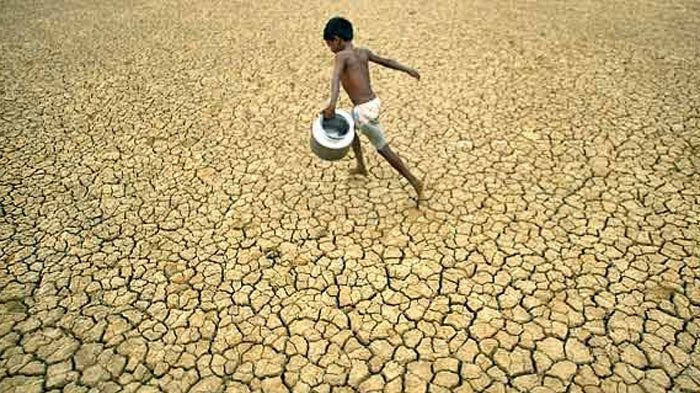
With country facing worst ever water crisis in decades, I request both the Government of India and Citizens of India to make definitive steps in this regard. First as a citizen can't we conserve water at every activity in our life. There is a famous quote in novel cloud atlas, “My life amounts to no more than one drop in a limitless ocean. Yet what is any ocean, but a multitude of drops?” remembering the same if every signatory of this petition sincerely vows to save water in each and every activity of life it could be substantial step. The routine tap running while shaving and brushing can be changed with mug, using bucket instead of shower, reusing water used for rice cooking and vegetable washing. Each of us can implement a rain water harvesting system with collection and ground water recharge and there are many more which many of us know but just don't follow. At same time I request Government of India to make mandatory laws and with strict implementation for both industrial and domestic use, for everyone alike, for recycling and conservation of water. Rain water harvesting should be made compulsory for any new construction hereon with. Water reservoirs for every major city to catch runoff water. Education drives at every level school, villages, communities and cities. An integrated approach of all ministries agriculture, environment, water resource etc. I'm requesting this because the place where I live over past two decades groundwater has receded by many meters and in spite of being water rich area. It is high time that every signatory should take a vow to save water and follow it with heart because we also have to change to make the world change, and I request Government of India to take measure now as our country can't prosper without water and all development plans depend on its very existence.  

50th Edition of World Science Awards 2026 to Celebrate Global Research and Innovation in London

  50th Edition of World Science Awards 2026 to Celebrate Global Research and Innovation in London The 50th Edition of World Science Awards ...