Wi-Fi itself refers to the popular wireless network technology which enables a Wireless Local Area Network, or WLAN. We know that the gadgets we use every day like mobile phones, laptops, smart TVs, etc., all have Wi-Fi capabilities. What this means is that these devices support frequencies at both 2.4 GHz and 5 GHz bandwidths. These frequencies are distinct from those used for phone, TV, and radio signals to prevent interference.
The term Wi-Fi was coined by a brand-consulting company called Interbrand in 1999 for the company promoting the technology called Wi-Fi Alliance as a more memorable name as compared to the technical name “IEEE 802.11”. The accidental association between the two was formed when Wi-Fi Alliance released a piece of communication containing a tagline for Wi-Fi which read: “The Standard for Wireless Fidelity”. This was just a promotion attempt by the company to make it easier for the home market to understand what Wi-Fi meant. What ended up happening, however, was that people came to believe that Wi-Fi in fact stood for Wireless Fidelity.
Wi-Fi Alliance has since retracted this tagline and offered clarification but they are choosing to focus on their successful popularisation and acceptance of Wi-Fi as a term. So while Wi-Fi and Wireless Fidelity are close relatives of each other, their meanings are not exactly the same.
Internet of Things (IoT)
The devices and gadgets that surround us have already become an indispensable part of our lives. But technology is at its best when it’s out of your way. This is where the Internet of Things as a concept shines on full display. An interconnected web of your devices all communicating with each other seamlessly has started to become a reality. The advent of Wi-Fi 6 means more and more devices will be able to get connected with each other and the exchange of information between them will get quicker and quicker.
Smart Cities
A robust data network enabling fast Wi-Fi speeds bodes well for the development of smart cities across the country. There is expected to be a dramatic improvement in living conditions through access to services and fast communication. Building and traffic management, along with utilities such as water and waste management are set to benefit.
International Research Awards on Science, Health and Engineering | April 24-25 2024 | Berlin, Germany
Electrical engineering is the field that develops electrical systems, equipment, and devices. Electrical engineers design complex electrical systems and also look after their maintenance. With tremendous technological advancements today, electrical engineers work in diverse industries including household appliance designing and manufacturing, power transmitters, electrical power structures, and even complex satellite communication devices. Electrical engineers are required to undergo intense training and skill-development to be able to work in these industries.
Let’s take a look at the top career insights for electrical engineering graduates: Electrical Engineering Courses
There are a number of undergraduate electrical engineering courses you can pursue to make it as an electrical engineer. Here are the most popular undergraduate electrical engineering courses: Diploma in Electrical Engineering
Eligibility Criteria:
Candidates must complete class 10th with 40% aggregate marks from a recognised educational board. They should opt for Mathematics and Physics as compulsory subjects. B.Tech in Electrical Engineering
Eligibility Criteria:
To qualify for this program, candidates have to complete 10+2 with Physics, Mathematics, and Chemistry as compulsory subjects. Candidates should score 50% aggregate marks to qualify for this program.
Top Job Opportunities for Electrical EngineersElectrical Engineer: An electrical engineer can be hired at different industries that undertake designing, producing, and manufacturing electrical equipment. Telecommunications Engineer: Telecommunications engineers are tasked with managing the transmission of information through optic fibre or cable wiring. Power Engineer: These engineers are tasked with designing, developing, and maintaining generators, motors, and transformers. Electrical Design Engineer: As the name suggests, this job profile entails designing and developing electrical systems, and creating prototypes of viable systems for manufacturing. Micro Electrical Engineer: They are responsible for dealing with micro-fabrication of minute electronic components and circuits.
International Research Awards on Science, Health and Engineering | April 24-25 2024 | Berlin, Germany
Mechanical engineering is one of the oldest, broadest, and widely-pursued engineering fields. Despite all the vagaries of the global economic crisis and meltdown, the job market for mechanical engineering continued to stand strong. Nevertheless, many students feel perplexed in choosing mechanical engineering as a profession, as there are so many other alluring career options available today. We, at the Indore Institute of Science & Technology, would like to assure that Mechanical Engineering is an evergreen professional arena and the demand for mechanical engineers in the job market is only going to surge with time. But for those who are contemplating to pursue this degree as their career, it is important you take a glance at the different angles of this stream and know how this field of education can unravel the paths to countless career opportunities.
The field of Mechanical Engineering is about creating all kinds of mechanical systems for different industries. Technically, this field of study deals with the concepts and principles of physics and mathematics along with engineering.As such, a wide range of industries like automobile, aeronautical, space research, bio-mechanical industry, energy and power, exploration and refining industries, and even agricultural sector can be a place of employment for those with a degree in mechanical engineering.With the rolling of time, the field of mechanical engineering has expanded beyond its boundaries and is becoming more of interdisciplinary in nature.
What Mechanical Engineers Do?
Mechanical engineers play a vital role in the development and working of various products ranging from mechanical equipment/systems to a vast assortment of industrial machinery. The application base for engineers in this field is extremely diverse and broad. Mechanical engineers generally remain involved in the process of designing, testing, manufacturing, installing, operating, and maintaining a wide array of industrial machinery. However, their roles and responsibilities do not remain limited to what we just mentioned above.
As a part of the job, mechanical engineers may be needed to deal with concepts of physics such as mechanics, thermodynamics, robotics, structural mechanics, fluid mechanics, kinematics, and muchmore. These are applied in the process of designing various manufacturing units, motor engines, power plants, heating/cooling systems, and other simple and complex machinery. Apart from these conventional roles and responsibilities, mechanical engineers are also involved in new areas of research and development such as nanotechnology, biomedical applications, and development of composite materials, thus extending the scope of mechanical engineering towards new avenues.
International Research Awards on Science, Health and Engineering | April 24-25 2024 | Berlin, Germany
Are you a tech enthusiast passionate about staying up-to-date with the latest advancements in science, technology, artificial intelligence, electronic gadgets, and anything related to technology but unsure where to find the information you are looking for? Look no further than http://www.advtoptech.com/, a platform dedicated to science and technology.
On the portal, tech enthusiasts and science buffs can easily access the latest announcements and information, as well as news and updates from the world of science and technology. It publishes upcoming field developments and covers various other topics, including projects, smartphones, gadgets, google technologies, and mobile applications.
In addition to sharing news and updates, the website seeks to introduce young audiences to new ideas they can pursue with these advancements in science. The platform also serves the purpose of helping those interested in learning about new technologies and their applications with a dedicated “how to” section.
“The impact of science and technology on our lives is greater than ever. The same is true with the general interest in the two vast fields. At any given time, there are so many developments in science and technology, but no platform helps readers stay abreast of these. And that is why we have created this platform that helps readers stay informed about the latest developments in these fields. With informative and interesting content, the website has grown into an established platform in a short period.
International Research Awards on Science, Health and Engineering | April 24-25 2024 | Berlin, Germany
‘Have you done your due diligence?’ These six words induce fear and dread in anyone involved in finance, with the underlying threat that huge peril may be about to engulf you if the necessary homework hasn’t been done. Due diligence in the commercial sphere is a hygiene factor – a basic, if detailed, audit of risk to ensure that all possible outcomes have been assessed so nothing comes out of the woodwork once an investment has been made.
The question, however, is just as important for academic institutions looking to check the data on their research programs: have you done your due diligence on that? If not, then a linked database such as Dimensions can help you.
Strategic Objectives
At a recent panel discussion hosted by Times Higher Education (THE) in partnership with Digital Science on optimizing research strategy, the question of due diligence was framed by looking at the academic research lifecycle and the challenges emanating from the increased amount of data now accessible to universities. More specifically, how universities could extract and utilize verified data from the ever–increasing number of sources they had at their disposal.
Speaking on the panel, Digital Science’s Technical Product Solutions Manager Ann Campbell believes there are numerous benefits to using new modes of data to overcome problems associated with data overload. “It’s important to think holistically, of not only the different systems that are involved here but also the different departments and stakeholders,” she said. “It’s better to have an overarching data model or a perspective from looking at the research life cycle instead of separate research silos or different silos of data that you find within these systems.”
The panel recognized that self–reporting for academics could lead to gaps in the data, while different impact data could also be missed due to a lack of knowledge or understanding on behalf of faculty members.
Digital Science seeks to address these problems by adding some power to its Dimensions linked database in the shape of Google BigQuery. By marrying this computing power to the size and scope of Dimensions, academics and research managers are empowered to identify specific data from all stages of the research lifecycle. This allows researchers to seamlessly combine external data with their own internal datasets, giving them the holistic view of research identified by Ann Campbell in the discussion.
Accessing Dimensions on Google BigQuery.
Data Savant
The theme of improving the capabilities of higher education institutions when it comes to data utilization has been most vividly described by Ann Campbell in her November presentation to the Times Higher Education Digital Universities conference in Barcelona in October. Memorably, she compared universities’ use of data to the plot of popular TV drama Game of Thrones. Professors as dragons? Rival departments as warring families? Well not quite, but what Ann did observe was that there are many competing elements within HEIs – research management, research information, academic culture, the library – and above them are senior management who have key questions that can only be answered using data and insights across all of them:
Which faculties have a high impact? Should we invest more in them?
Which faculties have high potential but are under–resourced?
How can we promote our areas of excellence?
How can we identify departments with strong links to industry?
What real–world research impact can we feed back into our curriculum?
Are we mitigating potential reputational risk through openness and transparency?
Bringing these disparate challenges together requires a narrative, which is another reason why the Game of Thrones analogy works so well as we see that for all the moving parts of the story to work, a coherent story is required. This can be how an institution’s research culture strategy is working with a rise in early career international collaborations, how an increase in new funding opportunities followed a drive to increase interdisciplinary collaborations, or how the global reputation of a university could be seen to have improved its impact rankings position due to increased SDG–related research.
Any good story needs to have the right ingredients, and where Digital Science can really help an institution is to bring together those ingredients from across an organization into viewable and manageable narratives.
Telling Stories
But the big picture is not the whole story, of course. There are other, smaller narratives swirling through HEIs at any given time that reflect the different specialisms, hot topics or focus areas of the university. Three of these focus areas most commonly found in modern universities are research integrity, industry partnerships and research impact, and these were discussed recently at another collaborative webinar between THE and Digital Science: Utilising data to deliver research integrity, industry partnerships and impact.
This panel discussion was a little more granular, and teased out some specific challenges for institutions when it came to data utilization. For research integrity, certain data relating to authorship can be used as ‘trust markers’, based around authorship, reproducibility and transparency. Representing Digital Science, Technical Product Solutions Manager Kathryn Weber–Boer went through the trust markers that form the basis of the Dimensions Research Integrity solution for universities.
But why are these trust markers important? The panel discussion also detailed that outside universities’ realm of interest, both funders and publishers were increasingly interested in research integrity and the provenance of research emanating from universities. As such, products like Dimensions Research Integrity were forming a key part of the data management arsenal that universities needed in the modern research funding environment.
In addition, utilization and scrutiny of such data can help move the dial in other important areas, such as changing research culture and integrity. Stakeholders want to trust in the research that’s being done, know it can be reproduced, and also see there is a level of transparency. All of these factors then influence the promotion and implementation of more open research activities.
Another important aspect of research integrity and data utilization is not just having information on where data is being shared in what way, it is also whether it is being shared as it has been recorded as, and where it is actually located. As pointed out in the discussion, Dimensions is a ‘dataset of datasets’ and allows the cross–referencing of these pieces of information to understand if research integrity data points are aligned.
Dimensions Research Integrity trust markers.
Positive Outlook
Discussions around research integrity and data management can often be gloomy affairs, but there is some degree of optimism now there are increasing numbers of products on the markets to help HEIs meet their goals and objectives in these spheres of activity. Effective data utilization will undoubtedly be one of THE critical success factors for universities in the future, and it won’t just be for the effective management of issues like research integrity or reputations. With the lightning fast development, adoption of Generative AI in the research space and increasing interest in issues like research security and international collaboration, data utilization – and who universities partner with to optimize it – has never been higher up the agenda.
Simon Linacre, Head of Content, Brand & Press | Digital Science
Simon has 20 years’ experience in scholarly communications. He has lectured and published on the topics of bibliometrics, publication ethics and research impact, and has recently authored a book on predatory publishing. Simon is an ALPSP tutor and has also served as a COPE Trustee.
Shortly after General Electric spun off its HealthCare division, the newly released company started buying AI technology. To share some strategic insights, Digital Science’s IFI CLAIMS Patent Services has taken a look at the target companies’ patents to see what capabilities they’re bringing into the medical technology company.
The phrase ‘patently obvious’ is used in many contexts, from political exchanges to newspaper op-ed columns. Curiously, it is rarely used in the realm of actual patents, but in the case of General Electric’s (GE) HealthCare division, its use seems entirely appropriate.
In early 2023, GE made the decision to spin off GE HealthCare, and immediately following the move the new entity started its M&A strategy by acquiring two companies of its own – Caption Health and IMACTIS. At this early stage, is it possible to infer whether these were sound investments? Six months later, there is still a way to go before full year financial results are posted along with other financial data. However, Digital Science company IFI CLAIMS Patent Services – a global patent database provider for application developers, data scientists, and product managers – can gain insights by looking into the patents the newly enlarged GE HealthCare now holds.
Patents = Strategic Insights
It should be ‘patently obvious’, but checking companies’ patents can be a part of any due diligence process before an investment decision is made. Not only does this help understand risk and technology overlaps, it can also be used to determine where R&D efforts are currently focused in the target acquisition, and in turn set the strategy for the newly merged entity. Analyzing a company’s patent holdings in the midst of M&A dealings provides insights, such as:
Strategic direction of companies (i.e., such as the extent to which they are making strides in AI)
Unique takes on M&A transactions as it is possible to determine – based on companies’ technologies – if core competencies overlap or not with the acquiring company
Ascertaining if a company’s core competencies are enhanced or not by the acquisitions it’s made
IFI’s latest acquisition report takes a look at GE HealthCare’s acquisitions of IMACTIS and Caption Health’s patented technologies to determine the innovative direction of the company.
‘A good fit’
So what insights can be gleaned from patent data about GE HealthCare and its nascent M&A strategy? According to the report, the acquisition of Caption Health and IMACTIS were a ‘good fit’ for GE HealthCare. Both the acquisitions point towards GE HealthCare’s continued growth in terms of both AI and the application of AI to its existing core technologies. Specifically:
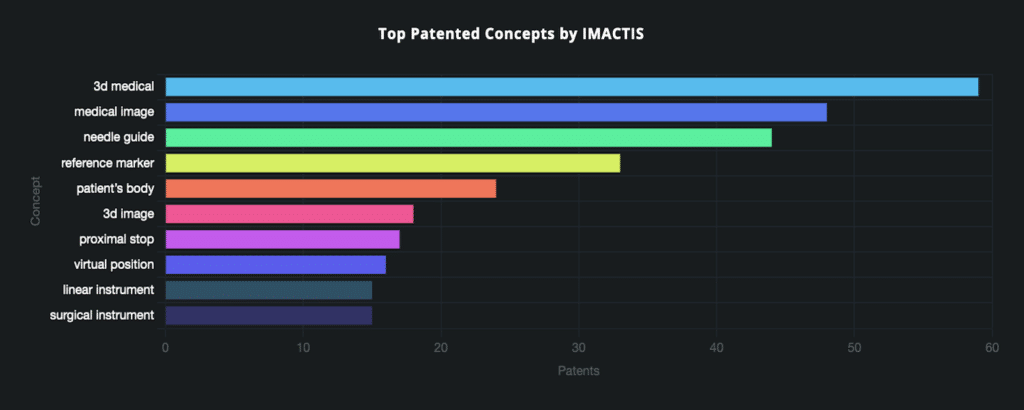
IMACTIS is a tech healthcare company that offers, among other things, the provision of 3D virtual imaging to surgical navigation
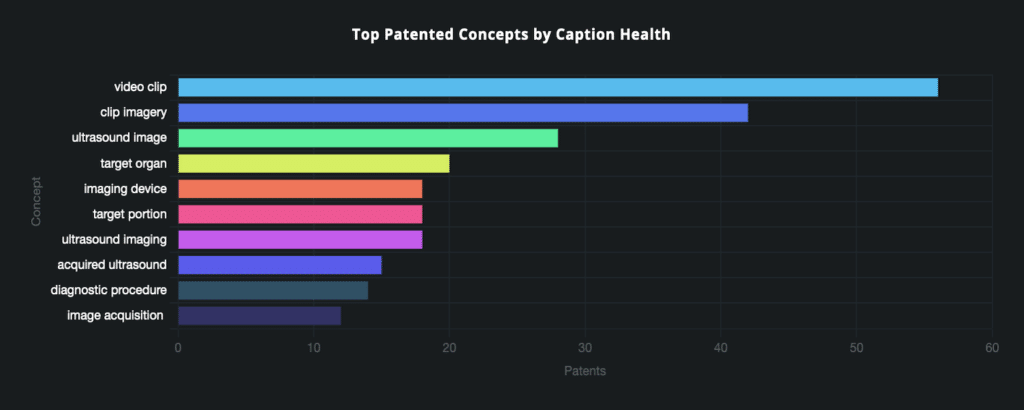
Caption Health focuses on providing AI capabilities and image data generation to ultrasound technologies
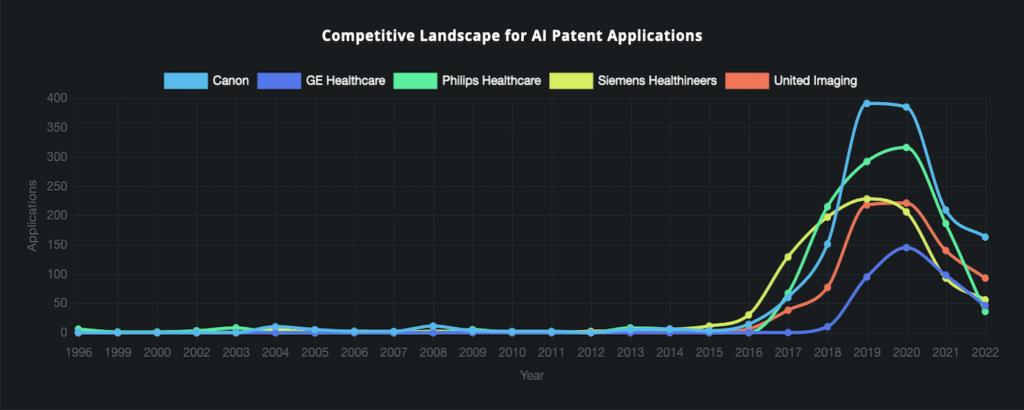
You can see from the chart below that GE HealthCare competes with a number of major companies in establishing AI-related patents, which surged in 2019-2020 before dipping in 2021. As such, the acquisitions in the early part of 2023 of companies that are focused on technology and AI in particular seem to be a good strategic move, especially given the furore around AI technology since late 2022.
The report concludes that both Caption Health and IMACTIS make sense for GE HealthCare for several reasons. In the current competitive climate, Caption Health adds necessary AI capabilities while IMACTIS adds new dimensions to the suite of patents it has with 3D virtual images. So overall, it’s a gold star for GE HealthCare when it comes to enhancing its patent – and future commercial – strategy. Isn’t that obvious?
1. Digital Science’s IFI CLAIMS Patent Services – a global patent database provider for application developers, data scientists, and product managers – can help customers gain insights by looking into the patents held by firms, such as newly enlarged GE HealthCare.
2. IFI’s latest acquisition report takes a look at GE HealthCare’s acquisitions of IMACTIS and Caption Health’s patented technologies to determine the innovative direction of the company – the report concludes that both Caption Health and IMACTIS make sense for GE HealthCare for a number of reasons.
3. Checking companies’ patents should be a part of any due diligence process before any corporate investment decision is made, especially in pharmaceuticals sector.
Simon Linacre, Head of Content, Brand & Press | Digital Science
Simon has 20 years’ experience in scholarly communications. He has lectured and published on the topics of bibliometrics, publication ethics and research impact, and has recently authored a book on predatory publishing. Simon is an ALPSP tutor and has also served as a COPE Trustee.
Digital Science, Figshare and Springer Nature are proud to publish The State of Open Data 2023. Now in its eighth year, the survey is the longest-running longitudinal study into researchers’ attitudes towards open data and data sharing.
The 2023 survey saw over 6,000 responses and the report that has now been published takes an in-depth look at the responses and purposefully takes a much more analytical approach than has been seen in previous years, unveiling unprecedented insights.
Five key takeaways from The State of Open Data 2023
Support is not making its way to those who need it
Over three-quarters of respondents had never received any support with making their data openly available.
One size does not fit all
Variations in responses from different subject expertise and geographies highlight a need for a more nuanced approach to research data management support globally.
Challenging stereotypes
Are later career academics really opposed to progress? The results of the 2023 survey indicate that career stage is not a significant factor in open data awareness or support levels.
Credit is an ongoing issue
For eight years running, our survey has revealed a recurring concern among researchers: the perception that they don’t receive sufficient recognition for openly sharing their data.
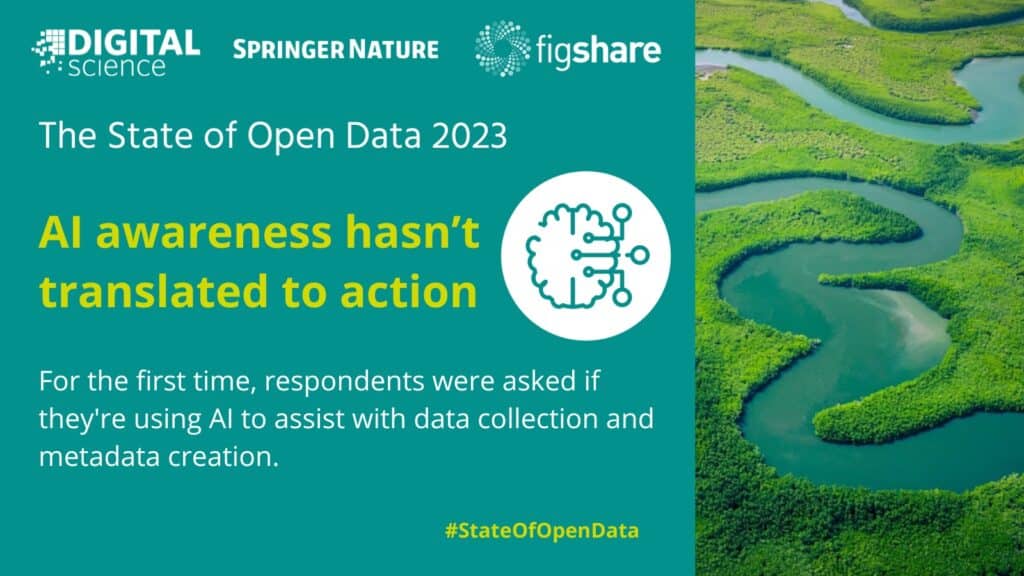
AI awareness hasn’t translated to action
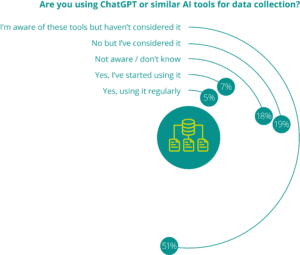
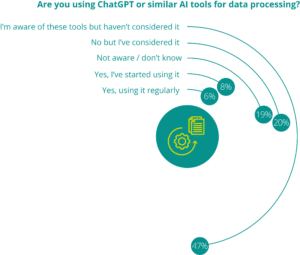
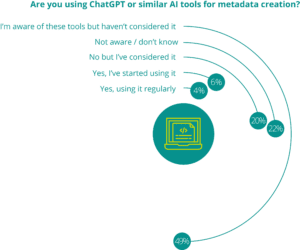
For the first time, this year we asked survey respondents to indicate if they were using ChatGPT or similar AI tools for data collection, processing and metadata creation.
Diving deeper into the data than ever before
This year, we dive deeper into the data than ever before and look at the differing opinions of our respondents when we compare their regions, career stages, job titles and subject areas of expertise.
Figshare founder and CEO Mark Hahnel said of this approach, “It feels like the right time to do this. Whilst a global funder push towards FAIR data has researchers globally moving in the same direction, it is important to recognize the subtleties in researchers’ behaviors based on variables in who they are and where they are.”
This year features extensive analysis of the survey results data and provides an in-depth and unique view of attitudes towards open data.
This analysis provided some key insights; notably that researchers at all stages of their careers share similar enthusiasm for open data, are motivated by shared incentives and struggle to overcome the same obstacles.
These results are encouraging and challenge the stereotype that more experienced academics are opposed to progress in the space and that those driving progress are primarily early career researchers.
We were also able to look into the nuanced differences in responses from different regions and subject areas of expertise, illuminating areas for targeted outreach and support. These demographic variations also led us to issue a recommendation to the academic research community to look to understand the ‘state of open data’ in their specific setting.
Benchmarking attitudes towards the application of AI
In light of the intense focus on artificial intelligence (AI) and its application this year, for the first time, we decided to ask our survey respondents if they were using any AI tools for data collection, processing or metadata collection.
The most common answer to all three questions was,“I’m aware of these tools but haven’t considered it.”
Although the results don’t yet tell a story, we’ve taken an important step in benchmarking how researchers are currently using AI in the data-sharing process. Within our report, we hear from Niki Scaplehorn and Henning Schoenenberger from Springer Nature in their piece ‘AI and open science: the start of a beautiful relationship?’ as they share some thoughts on what the future could hold for research data and open science more generally in the age of AI.
We are looking forward to evaluating the longitudinal response trends for this survey question in years to come as the fast-moving space of AI and its applications to various aspects of the research lifecycle accelerate farther ahead.
Recommendations for the road ahead
In our report, we have shared some recommendations that take the findings of our more analytical investigation and use them to inform action points for various stakeholders in the community. This is an exciting step for The State of Open Data, as we more explicitly encourage real-world action from the academic community when it comes to data-sharing and open data.
Understanding the state of open data in our specific settings: Owing to the variations in responses from different geographies and areas of expertise, we’re encouraging the academic community to investigate the ‘state of open data’ in their specific research setting, to inform tailored and targeted support.
Credit where credit’s due: For eight years running, our respondents have repeatedly reported that they don’t feel researchers get sufficient credit for sharing their data. Our recommendation asks stakeholders to consider innovative approaches that encourage data re-use and ultimately greater recognition.
Help and guidance for the greater good: The same technical challenges and concerns that pose a barrier to data sharing transcend different software and disciplines. Our recommendation suggests that support should move beyond specific platform help and instead tackle the bigger questions of open data and open science practices.
Making outreach inclusive: Through our investigation of the 2023 survey results, we saw that the stage of an academic’s career was not a significant factor in determining attitudes towards open data and we saw consensus between early career researchers and more established academics. Those looking to engage research communities should be inclusive and deliberate with their outreach, engaging those who have not yet published their first paper as well as those who first published over 30 years ago.
What’s next for The State of Open Data?
The State of Open Data 2023 report is a deliberate change from our usual format; usually, our report has contributed pieces authored by open data stakeholders around the globe. This year, we’ve changed our approach and we are beginning with the publication of this first report, which looks at the survey data through a closer lens than before. We’ve compared different subsets of the data in a way we haven’t before, in an effort to provide more insights and actionable data for the community.
In early 2024, we’ll be releasing a follow-up report, with a selection of contributed pieces from global stakeholders, reflecting on the survey results in their context. Using the results showcased in this first report as a basis, it’s our hope that this follow-up report will apply different contexts to these initial findings and bring new insights and ideas.
In the meantime, we’re hosting two webinars to celebrate the launch of our first report and share the key takeaways. In our first session, The State of Open Data 2023: The Headlines, we’ll be sharing a TL;DR summary of the full report; our second session, The State of Open Data 2023: In Conversation, will convene a panel of global experts to discuss the survey results.
Laura is the Marketing Director at Figshare, part of Digital Science. Before joining Digital Science, Laura worked in scholarly publishing, focusing on open access journal marketing and transformative agreements. In her current role, Laura focuses on marketing campaigns and outreach for Figshare. She is passionate about open science and is excited by the potential it has to advance knowledge sharing by enabling academic research communities to reach new and diverse audiences.