Wednesday, December 1, 2021

Dental device for snoring may slow onset of Alzheimer’s disease

Dental device for snoring may slow onset of Alzheimer’s disease

A good night’s sleep plays an essential role in regulating brain health by removing the waste material and toxins that accumulate. Although many things can disturb sleep, one of the most common causes is snoring or other breathing issues that cause obstructive sleep apnea. A team of researchers from Center for BrainHealth® at The University of Texas at Dallas and Texas A&M University sought to understand the relationship between breathing rate during sleep and cognitive function, and how a snoring intervention affects brain health.

The findings were published recently in Geriatrics by the team that included BrainHealth researchers Sandra Bond Chapman, PhD, chief director; Namrata Das, PhD, MD, MPH, a research neuroscientist in Alzheimer’s disease; and Jeffrey Spence, PhD, director of biostatistics. Lead researcher Preetam Schramm, PhD, a Visiting Scholar at Texas A&M University, designed the interventional study and provided the sleep science expertise.

The team discovered that maximum breathing rate can be used to distinguish healthy individuals from people with mild cognitive impairment and those with Alzheimer’s disease. The researchers also found that a dental device to reduce snoring improves cognitive function in individuals who suffer from mild cognitive impairment.

The team’s pilot study included 18 individuals aged 55-85 with a history of snoring. About one third of participants had mild cognitive impairment and another third had Alzheimer’s disease. To examine how breathing rate relates to an individual’s cognitive function, participants slept at home while portable recorders collected data on their breathing rate, heart rate and snoring. Clinicians from Center for BrainHealth assessed the participants’ memory, executive function, and attention.

The team found that the maximum breathing rate during uninterrupted periods of sleep can differentiate healthy individuals from individuals with either Alzheimer’s disease or mild cognitive impairment. “We saw three distinct patterns amongst the groups of people, meaning we can look for a breathing pattern that might predispose individuals to having dementia,” said Emet Schneiderman, PhD, a co-author on the study and Professor in the Department of Biomedical Sciences at Texas A&M University College of Dentistry. Determining breathing rate is cheaper and faster than other existing assessments for measuring an individual’s cognitive function and could be an effective testing alternative.

The researchers also looked at whether the myTAP oral appliance, which snaps into the mouth at night to prevent snoring, affects breathing rate and cognitive function. For four weeks, participants wore the device at night and snoring decreased. After the intervention period, cognitive function – especially in the domain of memory – no longer differed between healthy individuals and individuals with mild cognitive impairment. This suggests better sleep improves cognition in individuals with mild cognitive impairment. “If we can make significant changes for individuals with mild cognitive impairment, we can slow the onset of Alzheimer’s disease,” said Das, now a postdoctoral fellow at McLean Hospital, Harvard Medical School.

Though the team did not notice an overall difference in the cognitive function of participants with Alzheimer’s disease, researchers are hopeful that the intervention could work. On the individual level, half of the participants with Alzheimer’s disease saw improvements in their cognitive function. “Brain neurogenesis is a slow process, so perhaps these individuals may need a longer time period with the intervention to see any significant cognitive changes,” noted Das.

Alternatives to medicine for treating snoring, like dental appliances, could help individuals sleep better and improve their cognitive function. Sleep medications give individuals the impression that they’ve slept well, when in reality the brain never enters a deep phase of the sleep essential for the housekeeping process to rid the body of toxins.

And it now appears that alternative treatments, like this dental appliance, might produce meaningful changes in cognition before mild cognitive impairment progresses to Alzheimer’s disease. “Oral appliances could have a wide range of applications since sleep is affected by many different things across many different age groups,” said Das. “Maybe appliances could help individuals sleep better, reducing mental health symptoms caused by poor sleep before they get serious decline in neurocognitive symptoms.”


from ScienceBlog.com https://ift.tt/3ochFqI

First-in-human study of AI-discovered drug

First-in-human study of AI-discovered drug

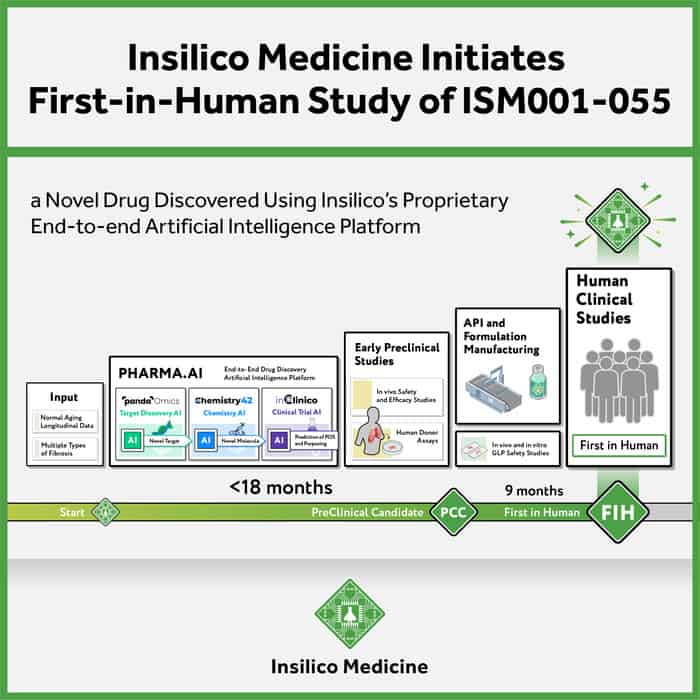
Insilico Medicine, an end-to-end artificial intelligence (AI)-driven drug discovery company, today announced that the first healthy volunteer has been dosed in a first-in-human microdose trial of ISM001-055.

The achievement is described in a lecture by Dr. Michael Levitt, the 2013 Nobel Laureate in Chemistry, in the context of the history of AI-powered drug discovery and a brief video explainer.

Since 2014, Insilico Medicine demonstrated its ability to identify novel targets using deep learning techniques and the ability to generate drug-like hit molecules using generative AI with the publication of the Generative Tensorial Reinforcement Learning (GENTRL) system for a well-known target in record time. It also demonstrated the target’s proof of concept by applying deep learning techniques for the identification of novel biological targets. This novel antifibrotic program combined these target discovery and generative chemistry capabilities. Notably, Insilico Medicine completed the entire discovery process from target discovery to preclinical candidate nomination within 18 months on a budget of $2.6 million. The story of the discovery is available on Insilico’s website with paper references and an explainer.

“Insilico Medicine has achieved this breakthrough milestone which is extremely impressive. Many drugs were discovered accidentally when scientists designed a drug for disease A and then they found out that it actually works for some different disease B. AI is a way to search for information and look for signals for drug discovery. This achievement didn’t happen by chance and is a reproducible method and procedure which is revolutionary,” said Michael Levitt, 2013 Nobel Laureate in Chemistry and member of Insilico Medicine’s Scientific Advisory Board.

ISM001-055 is a potentially first-in-class small molecule inhibitor of a novel biological target discovered by Pharma.AI, Insilico Medicine’s end-to-end AI-powered drug discovery platform. It is being developed for the treatment of idiopathic pulmonary fibrosis (IPF), a chronic lung disease which results in progressive and irreversible decline in lung function. After completing IND-enabling studies, Insilico Medicine has initiated the microdose trial to begin characterizing the pharmacokinetic profile in humans. The trial, administering ISM001-055 intravenously in healthy volunteers, is being conducted in Australia.

ISM001-055 demonstrated highly promising results in multiple preclinical studies including in vitro biological studies, pharmacokinetic and safety studies. The compound significantly improved myofibroblast activation which contributes to the development of fibrosis. ISM001-055’s novel target is potentially relevant to a broad range of fibrotic indications.

“We are very pleased to see Insilico Medicine’s first antifibrotic drug candidate entering into the clinic. We believe this is a significant milestone in the history of AI-powered drug discovery because to our knowledge the drug candidate is the first ever AI-discovered novel molecule based on an AI-discovered novel target. We have leveraged our end-to-end AI-powered drug discovery platform, including the usage of generative biology and generative chemistry, to discover novel biological targets and generate novel molecules with drug-like properties. ISM001-055 is the first such compound to enter the clinic, and we expect more to come in the near future,” said Feng Ren, Ph.D., CSO of Insilico Medicine.

“What impresses me the most about this achievement is not only the lower cost or faster speed of development but, also it demonstrated the Pharma AI platform can overcome the low probability of getting to this stage.” said Alex Zhavoronkov, Ph.D., Founder and CEO of Insilico Medicine. “There are very few examples of a pharmaceutical company discovering a new target for a broad range of diseases, designing a novel molecule, and initiating human clinical trials. To my knowledge, nobody has achieved this with AI to-date. The failure rates in preclinical target discovery are very high and even after the targets are validated in animal models, over half of Phase 2 clinical trials fail primarily due to the choice of target. Target discovery is the fundamental grand challenge of the pharmaceutical industry. With ISM001-055 we used end-to-end AI connecting biology, chemistry in order to assess activity and safety in multiple preclinical models.”

About Insilico Medicine

Insilico Medicine, an end-to-end artificial intelligence (AI)-driven drug discovery company, is connecting biology, chemistry, and clinical trials analysis using next-generation AI systems. The company has developed AI platforms that utilize deep generative models, reinforcement learning, transformers, and other modern machine learning techniques to discover novel targets and to design novel molecular structures with desired properties. Insilico Medicine is delivering breakthrough solutions to discover and develop innovative drugs for cancer, fibrosis, immunity, central nervous system (CNS) diseases and aging-related diseases. For more information, visit www.insilico.com.


from ScienceBlog.com https://ift.tt/3rrSrGW

Bringing 400-million-year-old fossilized armored worms to ‘virtual’ life

Bringing 400-million-year-old fossilized armored worms to ‘virtual’ life

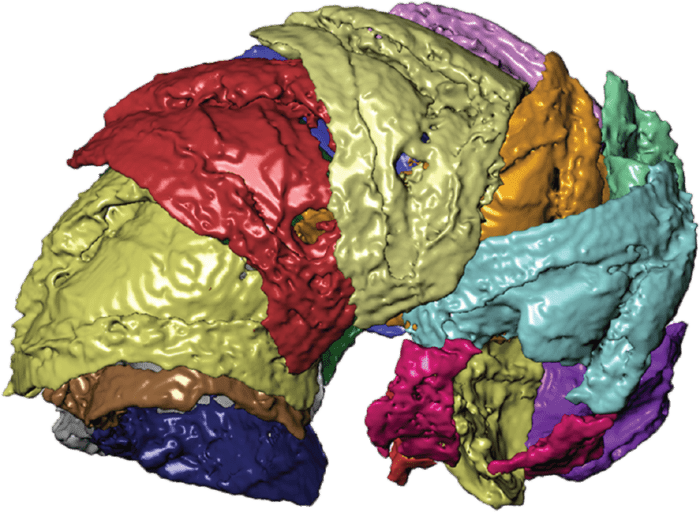
An international team of scientists from the United States and Australia, led by Sarah Jacquet at the University of Missouri, has documented the discovery of two new species of fossilized armored worms in Australia — Lepidocoleus caliburnus and Lepidocoleus shurikenus — dating from about 400 million years ago. Then, using the micro-CT imaging capabilities of the MU X-ray Microanalysis Core facility, the researchers were able to develop first-of-its-kind digital 3D-models of the species’ individual armor plates by virtually examining the armored skeletons of these ancient worms, called machaeridians.

Jacquet, an assistant professor of geological sciences in the MU College of Arts and Science, believes this study offers a new way for scientists to investigate how different biological armored systems worked throughout the fossil record.

“By using micro-CT, we can virtually separate the individual components of the armor,” Jacquet said. “That allows us to see how it protected these worms until, unfortunately, they went extinct during one of the major extinction events in the fossil record. We are able to manipulate the virtual models to determine how the individual armor pieces moved relative to each other, as well as determine the degree of overlap between them.”

At the time of their existence, these worms were likely living near coral reefs in shallow water on what is now land in Australia. The study identified these worms to have two overlapping armor systems — one going down the length of the organism’s skeleton, and the other down both sides of the worm. While no direct correlations have been made yet between these worms and any modern species, Jacquet believes her study can deepen our understanding of convergent evolution.

“Convergent evolution is where different and unrelated groups adapt similar features,” Jacquet said. “While this armor is a rather unique adaptation, and one that clearly does well for particular environments and protecting against particular predators, we do see other similar adaptations in a couple of unrelated animal groups, such as pangolins, pill bugs and millipedes.”

Jacquet said Lepidocoleus caliburnus is named after the famous sword “Excalibur” from the Arthurian legend, and Lepidocoleus shurikenus is named for its resemblance to the outline of shuriken, the Japanese word for throwing stars. She said future plans for this work include using virtual models to study how these armor systems fared against different types of stressors, such as under a predator attack.

“Sclerite assembly, articulation and protective system of Lower Devonian machaeridians,” was published in Papers in Paleontology. Other authors include Tara Selly and Jim Schiffbauer at MU, and Glenn Brock, who has dual appointments at Macquarie University in Australia and Northwest University in China.

Funding was provided by grants from the National Science Foundation (EAR CAREER-1652351 and EAR/IF-1636643) and internal research development grants from Macquarie University. The content is solely the responsibility of the authors and does not necessarily represent the official views of the funding agencies.


from ScienceBlog.com https://ift.tt/3lsHrFn

Extroverted? You may have better financial outcomes

Extroverted? You may have better financial outcomes

You might think the way you approach money is based on financial advice or past experiences, but new research from the University of Georgia shows that your personality may have a big impact on financial decision making and risk taking.

In a new study, psychology Ph.D. student Jim Exley investigates the “Big Five” personality traits: openness, conscientiousness, extroversion, agreeableness and neuroticism (OCEAN). He and a team of researchers identified three distinct combinations of traits with financial outcomes, specifying Resilient, Over Controlled and Under Controlled personality profiles that are associated with risk-taking and money management behaviors.

“Based on our results, the people with the best financial outcomes tend to be those who are well-adjusted, more extroverted and less neurotic,” said Exley. “They’re also willing to take some risks, but they don’t take too many.”

Exley was drawn to this research after working in the financial services industry for 25 years, where he encountered people’s varied approaches to finances firsthand. No one money personality was quite the same.

“The industry requires us to measure this thing called risk, but I was talking to people and understood that there’s more to somebody’s financial life than just their risk tolerance,” he said.

This epiphany led him to begin studying under W. Keith Campbell, professor of psychology in UGA’s Franklin College of Arts and Sciences. Campbell was the one who suggested personality might be at the root of the differences Exley noticed in his profession. Their research took off from there.

Three distinct approaches 

For Exley’s study, published in Personality and Individual Differences, the team surveyed 395 participants about personality, financial risk tolerance, net worth and happiness.

“Using advanced statistical modeling, we identified three overarching types of people based on combinations of their OCEAN scores,” said co-author Patrick Doyle, a recent Ph.D. graduate in psychology. “We then explored how members of those three groups differed in financial perspectives and experiences.”

The largest profile was the Over Controlled group, who exhibited high agreeableness and conscientiousness, but low extroversion. These people don’t like risk, so they avoid activities that are risky but could grow their wealth, like investing in the stock market.

The other two profiles are more tolerant of risk. The next largest, the Resilient group, are generally well-adjusted and stable people; they are extroverted, open and agreeable, and not very neurotic. These profiles were associated with more successful financial outcomes, because while they don’t avoid risks, they also don’t take too many.

Members of the Under Controlled group are less conscientious, and more extroverted and neurotic. They tend to enjoy taking risks, but they sometimes take too many, negatively affecting their net worth.

Guidance for financial planners

The team’s research shines light on an understudied topic. While money has a significant impact on better-researched subjects like marriage and parenting, it’s still relatively uncommon to explore the psychology behind the finances themselves, according to Campbell.

“It’s really interdisciplinary work,” he said. “It’s taking very basic models of personality, together with sophisticated statistics on psychometric approaches, and then applying them to very basic questions about investing and finance.”

With such strong associations between the profiles and financial outcomes, the researchers hope their findings will allow financial planners to better serve their clients, so they can help people make the best financial decisions for them.

“Planners, if they want to help people, need to measure OCEAN,” said Exley. “If people easily can talk about themselves—and it’s telling you a lot about how they handle money—then practitioners simply need to measure it and record it.”

John Grable, Athletic Association Professor in the UGA College of Family and Consumer Sciences, is also a co-author.


from ScienceBlog.com https://ift.tt/3penjYF

Researchers use AI to successfully detect signs of anxiety

Researchers use AI to successfully detect signs of anxiety

Researchers are using artificial intelligence (AI) to detect behavioural signs of anxiety with more than 90 per cent accuracy, and suggest that AI could have future applications for addressing mental health and wellbeing. Their research is published in the journal Pervasive and Mobile Computing.

“In the two years since the onset of COVID-19, and one climate disaster after another, more and more people are experiencing anxiety,” says Simon Fraser University visiting professor and social psychologist Gulnaz Anjum. “Our research appears to show that AI could provide a highly reliable measurement for recognizing the signs that someone is anxious.”

Anjum and collaborators Nida Saddaf Khan and Sayeed Ghani from the Institute of Business Administration in Karachi, Pakistan collected an extensive range of data from adult participants for their Human Activity Recognition (HAR) study. Participants performed a series of activities in a specific order while wearing sensors that recorded their movements.

The researchers created a dataset of activities of typical anxiety-displaying behaviours for the sensors to detect, including idle sitting, nail biting, knuckle cracking and hands tapping. Their behaviours were analyzed using deep learning algorithms and computational hybrid models.

Anxiety disorder is the most common form of mental disorder, according to the American Psychiatric Association (APA), impacting 30 per cent of the adult population at some point in their lives. The researchers suggest AI could help in the analysis, diagnosis, treatment and monitoring of psychological disorders such as anxiety disorder (AD).

“We’re hopeful that as more work is done to develop this method we can help to provide more accurate data for clinical research and practitioners,” says Anjum. “Our goal with this research is to expand horizons for the identification of anxiety disorders and ultimately, the improvement of people’s mental health.”

Khan says the rapid development in the field of AI and sensor technology “has made it possible to access and process the data related to mental, emotional and behavior disorders. It can be further researched and explored to understand unspoken behaviors and improve mental health at large.”

Ghani believes “there is tremendous opportunity for the healthcare industry to benefit from the applications of AI, and our research in using motion sensors for detecting anxiety-related behaviors is an example of what is possible.”


from ScienceBlog.com https://ift.tt/3phJXiH

Tuesday, November 30, 2021

Yale study: Unvaccinated white evangelicals appear immune to pro-vaccine messaging

Yale study: Unvaccinated white evangelicals appear immune to pro-vaccine messaging

White evangelical Christians have resisted getting vaccinated against COVID-19 at higher rates than other religious groups in the United States. A new study by Yale researchers provides evidence that persuading these vaccine holdouts to get their shots has only gotten more difficult.

The study, published in the journal Proceedings of the National Academy of Sciences, combines two survey experiments testing the effectiveness of various persuasive messages in shifting white evangelicals’ attitudes about vaccination. The first survey was conducted in October 2020, while Donald Trump was president and before the COVID-19 vaccines were approved for use in the United States, and the second occurred in May 2021, several months after people started getting jabs.

In the first survey, a message appealing to people’s sense of community interest, reciprocity, and the potential embarrassment of getting others sick after refusing the vaccines proved most effective in persuading white evangelicals to embrace vaccination. The second survey showed that these messages, as well as others, were no longer effective in May 2021 in changing unvaccinated white evangelicals’ views on the vaccines.

“At this point, unvaccinated white evangelicals seem resistant to messaging aimed at persuading them of the benefits of being vaccinated against COVID-19,” said Gregory A. Huber, the Forst Family Professor of Political Science in Yale’s Faculty of Arts and Sciences, and a co-author of the study. “It’s not clear whether this is because resistance to vaccination among white evangelicals has increased over time or that the current holdouts were always the least persuadable. What is clear is that messaging that was effective last fall, before vaccines were approved, now seems ineffective.”

Scholars and faculty from Yale’s School of Medicine, School of Public Health, School of Nursing, Institution for Social and Policy Studies, Department of Political Science, and the Institute for Global Health collaborated on the study with support from Yale’s Tobin Center for Economic Policy.

The initial survey, fielded on a nationally representative sample of 855 white evangelicals, gauged how various messages affected white evangelicals’ intentions to get vaccinated, their willingness to advise a friend to get the shots, and their judgments of people who refuse the vaccine. Respondents were randomly assigned to one of seven conditions: a placebo message unrelated to COVID-19, a baseline message about vaccine efficacy, or five treatment messages that added specific content to that baseline.

The treatment messages included an appeal to people’s community interest, emphasizing that vaccination protects others, who would in turn reciprocate that protection by getting vaccinated themselves. Another added language to the community interest message which evoked the embarrassment one would feel if they didn’t get vaccinated and infected somebody.

Three other messages were values based: One asserted that refusing the vaccine is reckless, not brave, and emphasized that getting vaccinated to protect others demonstrates real bravery; the second appealed to people’s sense of freedom by arguing that vaccination would end restrictions intended to contain COVID-19; and the third values-based message suggested that not getting vaccinated makes someone seem like they don’t understand science.

Overall, the message appealing to community interest, reciprocity, and a sense of embarrassment was the most persuasive, increasing all three outcomes relative to the placebo message: A 30% increase in intention to vaccinate, a 24% increase in willingness to advise a friend to get vaccinated, and a 38% increase in negative opinions of people who decline the vaccines.

However, the same message proved ineffective in the second survey, which was performed on a nationally representative sample of 2,419 unvaccinated white evangelicals. The message appealing to community interest and reciprocity also failed to persuade respondents, as did three revised values-based messages: one emphasizing former President Trump’s role in getting the vaccines developed; another stressing the point that vaccination would eliminate the need for government-mandated restrictions on personal freedom; and a third noting that people trust their doctors and that doctors support vaccination.

Neither survey showed that values-based messaging was successful at persuading white evangelicals to get vaccinated, contrasting with prior research that has found that values-consistent messaging increased positive attitudes towards masking among members of the same group.

“This study highlights the importance of testing and re-testing messages as the people requiring persuasion changes over time,” said Scott E. Bokemper, an associate research scientist at Yale’s Institution for Social and Policy Studies and the Center for American Politics, and co-author of the study. “It also demonstrates the difficulty in drawing broad conclusions from studies of population groups, even well-defined groups like white evangelical Christians, performed during a single point in time during the pandemic.”

Alan S. Gerber, the Charles C. & Dorathea S. Dilley Professor of Political Science at Yale, and Saad B. Omer, director of the Yale Institute for Global Health, were co-authors of the study.


from ScienceBlog.com https://ift.tt/3Eai96a

Courting success: why the ‘head’ outsmarts the body in basketball

Courting success: why the ‘head’ outsmarts the body in basketball

Two decades after his retirement, US basketballer Michael Jordan still holds the record for the highest paid athlete of all time, netting a cool $2 billion, demonstrating his global status in sport.

But what was is it about the star player that put him head and shoulders above his peers?

A new study led by University of South Australia PhD student Michael Rogers reveals why coaches believe ‘game intelligence’, work ethic and competitiveness – traits that Jordan possesses in spades – are far more important than physical fitness in determining success on the basketball court.

Rogers surveyed 90 basketball coaches from 23 countries to find out what factors – other than peak fitness – are used to recruit players for the big league.

“We found 35 performance indicators that coaches considered important and at the top of the list were psychological attributes,” Rogers says.

“Coaches look for players who are competitive, have a strong work ethic, are excellent communicators, good teammates and can ‘read’ the game. Being super fit is a given. It is the other traits that make a difference to the scoreboard.

“Game statistics are commonly used to recruit basketball players but by watching players on the court, and how they behave outside of it, coaches can pick up a lot of non-physical factors that indicate whether a player is likely to make the grade.”

Of the 35 performance indicators used by basketball coaches, 14 are psychological and four of these – attitude, coachability, competitiveness and work ethic – are considered more important than anything.

“Basketball players who are optimistic, easily taught and trained, and determined to be more successful and to work harder than others are favoured by coaches,” Rogers says.

Coaches indicated that players who put themselves ahead of their team were not good picks.

Mental toughness is also critical, because the ability to focus on every play, especially when tired, reflects on the scoreboard.

“Resilience, motivation, and good communication on the court are crucial in separating the ‘best from the rest’ once players reach elite level, according to the coaches we surveyed.

“Interestingly, the least important indicators were physical fitness and movement skills.”

The study, published in Sports Medicine, is the first to examine key indicators for recruitment in basketball using a large international panel of elite countries from FIBA-ranked countries.

A video explaining the study can be found at: https://youtu.be/M8uy12_p5sA

Player profiling and monitoring in basketball: A Delphi study of the most important non-game performance indicators from the perspective of elite athlete coaches” is published in Sports Medicine. For a copy of the paper please email candy.gibson@unisa.edu.au


from ScienceBlog.com https://ift.tt/3I8MTa8

Tbilisi State University Achieves Global Recognition for Research Excellence

Tbilisi State University Achieves Global Recognition for Research Excellence Tbilisi State University (TSU) has been highlighted for its s...