Tuesday, August 31, 2021

How future trains could be less noisy

How future trains could be less noisy

by Sarah Wild

Rail transportation is core to Europe’s plans to become carbon neutral by 2050, but noisy trains are an obstacle that will need to be first overcome.

‘We have a lot of resistance from people (living) beside the tracks who are against all construction and upgrades of the lines,’ said Rudiger Garburg, senior consultant for noise and vibrations technology at German railway company Deutsche Bahn AG. ‘It really is a bottleneck, (when) we speak about transforming transport and transferring traffic from road to rail.’

Greenhouse gas emissions from transport in Europe increased in 2018 and 2019, according to the European Environment Agency, and road transport was responsible for almost three-quarters of those emissions. In its ‘Sustainable and Smart Mobility Strategy’, the European Commission aims to shift traffic from road to rail and double its high-speed passenger rail traffic across Europe by 2030 and double rail freight by 2050.

To get community buy-in, however, governments and rail companies need to reduce rail noise. ‘Noise is always a problem of the system, not just the train,’ said Garburg, who is a member of Shift2Rail’s FINE 1 and FINE 2 projects to reduce noise, vibrations and energy use. A railway system includes the trains, their wheels, the rails, and the tracks that support them.

For passenger and freight trains, which move at between 60km and 200km per hour, the noise is mainly generated between the wheels and the rail. However, it is very difficult to determine which part of the system is making the noise.

FINE 1, which involved partners in rail, mobility and automation, was a broad project to curb excess noise and energy from trains. It looked to model and predict noise sources, among other objectives. This information is vital for both regulators and for train manufacturers.

The project, for example, was able to simulate the noise both inside and outside the train made by cast iron wheels compared to composite-material wheels. ‘In the past, trains used a cast-iron braking system for the wheels,’ Garburg explained. While good for braking, the iron sheared over time, making the wheels very rough – and noisy. ‘In past years, we’ve worked very hard to find more braking blocks (made out of) composite materials, not cast iron.’

Limit

In 2019, Europe’s revised train noise standards, part of a larger suite of rail specifications, came into force. Unlike cars, where manufacturers produce thousands of vehicles, train manufacturers only produce a limited number. ‘You cannot build a prototype, test it, and work on it,’ explained Garburg. ‘If you build a new train, you have to guarantee that your train adheres to this limit of noise, similar to air pollution and so on.’

As part of FINE 1, project members developed verifiable, realistic requirements to characterise noise sources. These specifications are important to create standards for manufacturers to follow, and ultimately make trains quieter. Its successor, FINE 2, plans to take this research even further and fine-tune its noise source prediction models.

‘In FINE 2, we have special measurement procedures,’ Garburg said. The team uses an ‘acoustic camera’, an array of 30-40 microphones, to capture the sound of the rail system. He likens it to a thermal camera, in which ‘you see yellow, red and green parts of a building’ to create a heat map. ‘We will use such procedures for the noise to get pictures that show you clearly where the main noise sources are,’ he said.

Better models could also enable train manufacturers to possibly obtain virtual certification for their trains to show that they adhere to the EU standards. All trains need to be certified by regulatory authorities before they are allowed on the track, but this process can be expensive and time-consuming.

In Shift2Rail’s partner project TRANSIT, virtual certification is the ‘dream on the horizon’, says Ines Lopez Arteaga, a professor of mechanical engineering at Eindhoven University of Technology in the Netherlands. ‘It would save a lot of money and time and resources to be able to do it based on calculations.’

But there are many research milestones to reach first, said Prof. Lopez Arteaga, who is TRANSIT project leader. We have tools to predict where train noise originates, but they could be improved, she says.

‘Noise is always a problem of the system, not just the train.’

Rudiger Garburg, Deutsche Bahn AG

Certified

At the moment, she says it is possible to measure the overall noise a train makes on the tracks, but the estimation of the separate components needs to be more accurate. With this information, it would be possible to not only make trains quieter, but make it easier to get new trains certified.

But trains also need to be tested on a specific type of track – one whose smoothness would not handicap or give overly positive noise measurements. She likens trains on the track to a child playing with marbles. ‘If you roll a marble on a table, it makes noise. With trains, it’s the wheels on the track. You get a different noise depending on the roughness of the table, if it’s stainless steel or wooden, for example,’ she said.

‘It is not easy to find the right track,’ explained Prof. Lopez Arteaga. ‘You would expect that with so many thousands of kilometres of rail in Europe that it shouldn’t be such a problem, but it is.’

One of the project’s goals is to translate the noise measurements from one track to another. ‘That would be a really big advantage,’ she said. ‘That would reduce the constraints on the type of track you can test on.’

Noise

There are also other components, aside from the wheels and rails, that add to the noise a train makes when it passes.

For example, older trains had their air conditioning units underneath the carriage, but modern trains have been lowered to allow people with less mobility to enter and exit the carriage more easily. As a result, air conditioning units are now on top of the carriage, where they add to the train noise.

‘The models we are developing with help from manufacturers aim to establish better requirements for their equipment,’ said Prof. Lopez Arteaga.

The aspect of the project that she is particularly excited about is modelling is the identification of noise sources on high-speed trains. ‘They want us to identify the noise, but also the direction it’s going. That’s really, really a challenge.’

Once the TRANSIT team has its results, it will share them with FINE 2 to evaluate in order to verify their findings, Prof. Lopez Arteaga says.

All of these are ‘small steps’ on the way to characterising the behaviour of the whole rail system, she says. ‘I love trains; they are a really interesting system. The whole railway – the network, the system, the trains – is so complex, there’s much more than meets the eye.’

The research in this article was funded by the Shift2Rail initiative. 

This article was originally published in Horizon, the EU Research and Innovation Magazine.


from ScienceBlog.com https://ift.tt/3Bq4l5I

Monday, August 30, 2021

Who can bend light for cheaper internet?

Who can bend light for cheaper internet?

Wide Area Networks (WANs), the global backbones and workhorses of today’s internet that connect billions of computers over continents and oceans, are the foundation of modern online services. As Covid-19 has placed a vital reliance on online services, today’s networks are struggling to deliver high bandwidth and availability imposed by emerging workloads related to machine learning, video calls, and health care. 

To connect WANs over hundreds of miles, fiber optic cables that transmit data using light are threaded throughout our neighborhoods, made of incredibly thin strands of glass or plastic known as optical fibers. While they’re extremely fast, they’re not always reliable: They can easily break from weather, thunderstorms, accidents, and even animals. These tears can cause severe and expensive damage, resulting in 911 service outages, lost connectivity to the internet, and inability to use smartphone apps. 

Scientists from the MIT Computer Science and Artificial Intelligence Laboratory (CSAIL) and from Facebook recently came up with a way to preserve the network when the fiber is down, and to reduce cost. Their system, called “ARROW,” reconfigures the optical light from a damaged fiber to healthy ones, while using an online algorithm to proactively plan for potential fiber cuts ahead of time, based on real-time internet traffic demands. 

ARROW is built on the crossroads of two different approaches: “failure-aware traffic engineering,” a technique that steers traffic to where the bandwidth resources are during fiber cuts, and “wavelength reconfiguration,” which restores failed bandwidth resources by reconfiguring the light. 

Though this combination is powerful, the problem is mathematically difficult to solve because of its NP-hardness in computational complexity theory. 

The team created a novel algorithm that can essentially create “LotteryTickets” as an abstraction for the “wavelength reconfiguration problem” on optical fibers and only feed essential information into the “traffic engineering problem.” This works alongside their “optical restoration method,” which moves the light from the cut fiber to “surrogate’’ healthy fibers to restore the network connectivity. The system also takes real-time traffic into account to optimize for maximum network throughput. 

Using large-scale simulations and a testbed, ARROW could carry 2 to 2.4 times more traffic without having to deploy new fibers, while maintaining the network highly reliable. 

“ARROW can be used to improve service availability, and enhance the resiliency of the internet infrastructure against fiber cuts. It renovates the way we think about the relationship between failures and network management — previously failures were deterministic events, where failure meant failure, and there was no way around it except over-provisioning the network,” says MIT postdoc Zhizhen Zhong, the lead author on a new paper about ARROW. “With ARROW, some failures can be eliminated or partially restored, and this changes the way we think about network management and traffic engineering, opening up opportunities for rethinking traffic engineering systems, risk assessment systems, and emerging applications too.”

The design of today’s network infrastructures, both in data centers and in wide-area networks, still follow the “telephony model,” where network engineers treat the physical layer of networks as a static black box with no reconfigurability. 

As a result, the network infrastructure is equipped to carry the worst-case traffic demand under all possible failure scenarios, making it inefficient and costly. Yet, modern networks have elastic applications that could benefit from a dynamically reconfigurable physical layer, to enable high throughput, low latency, and seamless recovery from failures, which ARROW helps enable.  

In traditional systems, network engineers decide in advance how much capacity to provide in the physical layer of the network. It might seem impossible to change the topology of a network without physically changing the cables, but since optical waves can be redirected using tiny mirrors, they’re capable of quick changes: no rewiring required. This is a realm where the network is no longer a static entity but a dynamic structure of interconnections that may change depending on the workload. 

Imagine a hypothetical subway system where some trains might fail once in a while. The subway control unit wants to plan how to distribute the passengers to alternative routes while considering all possible trains and traffic on them. Using ARROW, then, when a train fails, the control unit just announces to the passengers the best alternative routes to minimize their travel time and avoid congestion. 

“My long-term goal is to make large-scale computer networks more efficient, and ultimately develop smart networks that adapt to the data and application,” says MIT Assistant Professor Manya Ghobadi, who supervised the work. “Having a reconfigurable optical topology revolutionizes the way we think of a network, as performing this research requires breaking orthodoxies established for many years in WAN deployments.’ 

To deploy ARROW in real-world wide-area networks, the team has been collaborating with Facebook and hopes to work with other large-scale service providers. “The research provides the initial insight into the benefits of reconfiguration. The substantial potential in reliability improvement is attractive to network management in production backbone,” says Ying Zhang, a software engineer manager at Facebook who collaborated on this research. 

“We are excited that there would be many practical challenges ahead to bring ARROW from research lab ideas to real-world systems that serve billions of people, and possibly reduce the number of service interruptions that we experience today, such as less news reports on how fiber cuts affect internet connectivity,” says Zhong. “We hope that ARROW could make our internet more resilient to failures with less cost.” 

Zhong wrote the paper alongside Ghobadi; MIT graduate student Alaa Khaddaj; and Facebook engineers Jonathan Leach, Ying Zhang, and Yiting Xia. They presented the research at ACM’s SIGCOMM conference.

This work was led by MIT in collaboration with Facebook. The technique is being evaluated for deployment at Facebook. Facebook provided resources for performing the research. The MIT affiliated authors were supported by Advanced Research Projects Agency–Energy, the Defense Advanced Research Projects Agency, and the U.S. National Science Foundation.


from ScienceBlog.com https://ift.tt/3gK936m

Drug delivery capsule could replace injections for protein drugs

Drug delivery capsule could replace injections for protein drugs

In recent years, scientists have developed monoclonal antibodies — proteins that mimic the body’s own immune defenses — that can combat a variety of diseases, including some cancers and autoimmune disorders such as Crohn’s disease. While these drugs work well, one drawback to them is that they have to be injected.

A team of MIT engineers, in collaboration with scientists from Brigham and Women’s Hospital and Novo Nordisk, is working on an alternative delivery strategy that could make it much easier for patients to benefit from monoclonal antibodies and other drugs that usually have to be injected. They envision that patients could simply swallow a capsule that carries the drug and then injects it directly into the lining of the stomach.

“If we can make it easier for patients to take their medication, then it is more likely that they will take it, and healthcare providers will be more likely to adopt therapies that are known to be effective,” says Giovanni Traverso, the Karl van Tassel Career Development Assistant Professor of Mechanical Engineering at MIT and a gastroenterologist at Brigham and Women’s Hospital.

In a study appearing today in Nature Biotechnology, the researchers demonstrated that their capsules could be used to deliver not only monoclonal antibodies but also other large protein drugs such as insulin, in pigs.

Traverso and Ulrik Rahbek, vice president at Novo Nordisk, are the senior authors of the paper. Former MIT graduate student Alex Abramson and Novo Nordisk scientists Morten Revsgaard Frederiksen and Andreas Vegge are the lead authors.

Targeting the stomach

Most large protein drugs can’t be given orally because enzymes in the digestive tract break them down before they can be absorbed. Traverso and his colleagues have been working on many strategies to deliver such drugs orally, and in 2019, they developed a capsule that could be used to inject up to 300 micrograms of insulin.

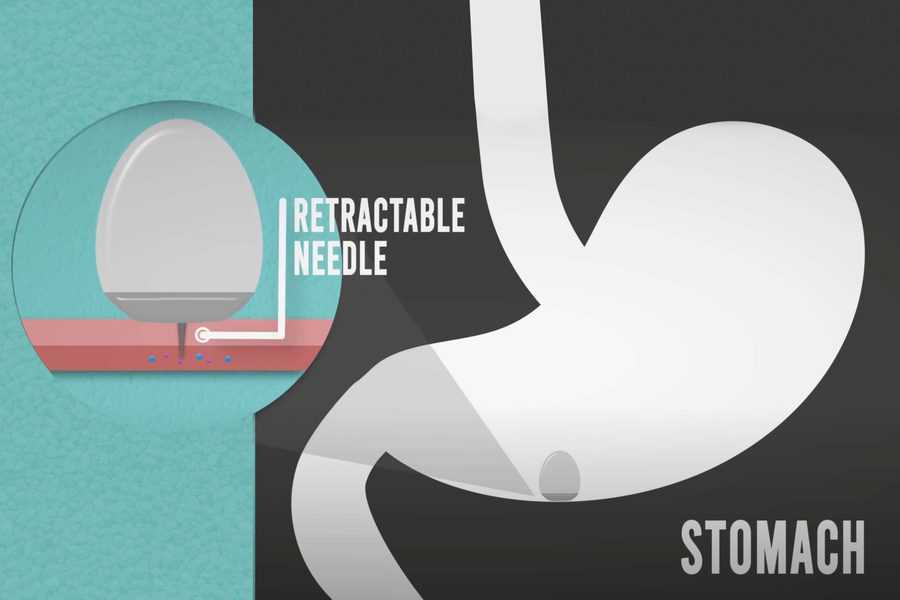
That pill, about the size of a blueberry, has a high, steep dome inspired by the leopard tortoise. Just as the tortoise is able to right itself if it rolls onto its back, the capsule is able to orient itself so that its needle can be injected into the lining of the stomach. In the original version, the tip of the needle was made of compressed insulin, which dissolved in the tissue after being injected into the stomach wall.

The new pill described in the Nature Biotechnology study maintains the same shape, allowing the capsule to orient itself correctly once it arrives in the stomach. However, the researchers redesigned the capsule interior so that it could be used to deliver liquid drugs, in larger quantities — up to 4 milligrams.

Delivering drugs in liquid form can help them reach the bloodstream more rapidly, which is necessary for drugs like insulin and epinephrine, which is used to treat allergic responses.

The researchers designed their device to target the stomach, rather than later parts of the digestive tract, because the amount of time it takes for something to reach the stomach after being swallowed is fairly uniform from person to person, Traverso says. Also, the lining of the stomach is thick and muscular, making it possible to inject drugs while mitigating harmful side effects.

The new delivery capsule is filled with fluid and also contains an injection needle and a plunger that helps to push the fluid out of the capsule. Both the needle and plunger are held in place by a pellet made of solid sugar. When the capsule enters the stomach, the humid environment causes the pellet to dissolve, pushing the needle into the stomach lining, while the plunger pushes the liquid through the needle. When the capsule is empty, a second plunger pulls the needle back into the capsule so that it can be safely excreted through the digestive tract.

Significant levels

In tests in pigs, the researchers showed that they could deliver a monoclonal antibody called adalimumab (Humira) at levels similar to those achieved by injection. This drug is used to treat autoimmune disorders such as inflammatory bowel disease and rheumatoid arthritis. They also delivered a type of protein drug known as a GLP-1 receptor agonist, which is used to treat type 2 diabetes.

“Delivery of monoclonal antibodies orally is one of the biggest challenges we face in the field of drug delivery science,” Traverso says. “From an engineering perspective, the ability to deliver monoclonal antibodies at significant levels really transforms how we start to think about the management of these conditions.”

Additionally, the researchers gave the animals capsules over several days and found that the drugs were delivered consistently each time. They also found no signs of damage to the stomach lining following the injections, which penetrate about 4.5 millimeters into the tissue.

David Brayden, a professor of advanced drug delivery at University College Dublin, who was not involved in the research, described the new approach as “a very exciting advance for the potential oral delivery of macromolecules. That similar blood levels to those arising from injections of these types of drugs can be achieved by stomach administration to large animals is a technical landmark for the field.”

The MIT team is now working with Novo Nordisk to further develop the system.

“Although it is still early days, we believe this device has the potential to transform treatment regimens across a range of therapeutic areas,” Rahbek says. “The ongoing research and development of this approach mean that several drugs that can currently only be administered via parenteral injections (non-oral routes) might be administered orally in the future. Our aim is to get the device into clinical trials as soon as possible.”

Other authors of the paper include MIT’s David H. Koch Institute Professor Robert Langer, Brian Jensen Mette Poulsen, Brian Mouridsen, Mikkel Oliver Jespersen, Rikke Kaae Kirk, Jesper Windum, Frantisek Hubalek, Jorrit Water, Johannes Fels, Stefan Gunnarsson, Adam Bohr, Ellen Marie Straarup, Mikkel Wennemoes Hvitfeld Ley, Xiaoya Lu, Jacob Wainer, Joy Collins, Siddartha Tamang, Keiko Ishida, Alison Hayward, Peter Herskind, Stephen Buckley, and Niclas Roxhed.

The research was funded by Novo Nordisk, the National Institutes of Health, the National Science Foundation, MIT’s Department of Mechanical Engineering, Brigham and Women’s Hospital’s Division of Gastroenterology, and the Viking Olof Bjork scholarship trust.


from ScienceBlog.com https://ift.tt/2V06sxD

Turning cameras off during virtual meetings can reduce fatigue

Turning cameras off during virtual meetings can reduce fatigue

More than a year after the pandemic resulted in many employees shifting to remote work, virtual meetings have become a familiar part of daily life. Along with that may come “Zoom fatigue” – a feeling of being drained and lacking energy following a day of virtual meetings.

New research conducted by Allison Gabriel, McClelland Professor of Management and Organizations and University Distinguished Scholar in the University of Arizona Eller College of Management, suggests that the camera may be partially to blame.

Gabriel’s research, published in the Journal of Applied Psychology, looks at the role of cameras in employee fatigue and explores whether these feelings are worse for certain employees.

“There’s always this assumption that if you have your camera on during meetings, you are going to be more engaged,” Gabriel said. “But there’s also a lot of self-presentation pressure associated with being on camera. Having a professional background and looking ready, or keeping children out of the room are among some of the pressures.”

After a four-week experiment involving 103 participants and more than 1,400 observations, Gabriel and her colleagues found that it is indeed more tiring to have your camera on during a virtual meeting.

“When people had cameras on or were told to keep cameras on, they reported more fatigue than their non-camera using counterparts,” Gabriel said. “And that fatigue correlated to less voice and less engagement during meetings. So, in reality, those who had cameras on were potentially participating less than those not using cameras. This counters the conventional wisdom that cameras are required to be engaged in virtual meetings.”

Gabriel also found that these effects were stronger for women and for employees newer to the organization, likely due to added self-presentation pressures.

“Employees who tend to be more vulnerable in terms of their social position in the workplace, such as women and newer, less tenured employees, have a heightened feeling of fatigue when they must keep cameras on during meetings,” Gabriel said. “Women often feel the pressure to be effortlessly perfect or have a greater likelihood of child care interruptions, and newer employees feel like they must be on camera and participate in order to show productiveness.”

Gabriel suggests that expecting employees to turn cameras on during Zoom meetings is not the best way to go. Rather, she says employees should have the autonomy to choose whether or not to use their cameras, and others shouldn’t make assumptions about distractedness or productivity if someone chooses to keep the camera off.

“At the end of the day, we want employees to feel autonomous and supported at work in order to be at their best. Having autonomy over using the camera is another step in that direction,” Gabriel said.

This research was co-authored by Eller doctoral student Mahira Ganster, Kristen M. Shockley with the University of Georgia, Daron Robertson with Tucson-based health care services company BroadPath Inc., Christopher Rosen with the University of Arkansas, Nitya Chawla with Texas A&M University and Maira Ezerins with the University of Arkansas.


from ScienceBlog.com https://ift.tt/3gJQi33

Proning manoeuvre dramatically improves COVID-19 patients’ blood oxygen levels

Proning manoeuvre dramatically improves COVID-19 patients’ blood oxygen levels

A new protocol for prone positioning — a technique commonly used to treat COVID-19 patients in respiratory distress by turning them on to their front to increase oxygen flow to the lungs, is published in the Journal of Frailty and Aging. Researchers from the University of Bristol in collaboration with clinicians at the Royal United Hospital in Bath, conducted a literature review of the manoeuvre to develop a standard protocol for the adjuvant treatment that can be used for COVID-19 patients at high risk of dying being treated in normal hospital wards.

Used to relieve hypoxia (low blood oxygen) since the 1970s, proning is associated with improving outcomes in those in respiratory distress and is commonly used during anaesthesia and in patients who are intubated and ventilated. Yet despite its use over several decades, there is limited guidance for clinicians on the optimal use of the manoeuvre and requisite monitoring.

Proning manoeuvre dramatically improves COVID-19 patients’ blood oxygen levelsA multidisciplinary team with expertise in caring for older adults with acute COVID-19 infection and based in the Ageing and Movement Research Group in Bristol’s Population Health Sciences sought to design a means by which alternative positioning of people with severe lung infections could improve their oxygen levels. They reviewed five studies that provided details of the technique which involved patients being cared for whilst lying on their fronts. This procedure is widely used in intensive care environments, but expertise, familiarity and staffing levels often preclude its use in normal NHS ward environments.

Two of the five studies tested the protocol in patients with non-invasive ventilation, and three described a protocol but did not test it in patients. Using the data from these five articles and from relevant clinical guidelines the study showed as well as being cost effective, when patients are positioned prone their oxygenation improves dramatically.   While the studies did not provide conclusive evidence to suggest a consensus on optimal duration in the COVID-19 population, studies that compared duration show a trend towards longer periods being of greater benefit.

Dr Emily Henderson, an Honorary Consultant Geriatrician at the Royal United Hospital Bath and Senior Lecturer at the University of Bristol and the study’s senior author, said: “Working on the frontline throughout the pandemic, I have sadly seen a large number of older adults in particular, die as a result of severe Covid-19 infection. Prone positioning is often used in intensive care settings and was a successful strategy that we trialled during the pandemic. We were struck by how little research there was to guide who this might benefit from this and how it could be adopted into practice safely. We are delighted to have developed a protocol for this potential adjuvant treatment. We look forward to exploring whether this, in addition to the drug treatments that are being developed and tested in large trials, may improve survival and outcomes. This strategy has particular utility for older people who are often looked after in NHS ward environments with Covid-19 infection.

Danielle Brazier, an academic physiotherapist at the University of Bristol, added: “Prone positioning for people with Covid-19 is a promising option but there’s a lot that needs to be considered prior to and during the procedure. We have designed a simple protocol to guide clinicians caring for people with Covid-19 infection. It was great to work with a multidisciplinary team of academics and clinicians to develop this guide.”

Prone Positioning of Older Adults with COVID-19: A Brief Review and Proposed Protocol by D. Brazier, N. Perneta, F.E. Lithander, E.J. Henderson in the Journal of Frailty and Aging.


from ScienceBlog.com https://ift.tt/38rPhYK

New beautiful, dragon-like species of lizard discovered in the Tropical Andes

New beautiful, dragon-like species of lizard discovered in the Tropical Andes

The Huallaga River in the Andes of central Peru extends for 1,138 km, making it the largest tributary of the Marañón River, the spinal cord of the Amazon River. This basin harbours a great variety of ecosystems, including the Peruvian Yunga ecoregion, which is considered a shelter of endemic birds, mammals, reptiles and amphibians.

How is it possible, then, that this corner of the Tropical Andes remains poorly known to biologists to this day? The main reason is indeed a quite simple one and it lies in the civil wars with terrorist organisations and drug traffickers that were going on in the region in the 1980s, disrupting biological studies.

It wasn’t until the late 1990s that the Peruvian government was able to liberate the area, and that’s when, little by little, some biologists began to venture back to the Huallaga Valley. However, forest destruction by coca plantations during the internal war, which eventually led to the construction of a hydroelectric power plant, left the Huallaga valley highly fragmented, making for an even more urgent need for biodiversity research in the area.

A new species of wood lizard, Enyalioides feiruzae, was recently confirmed from the premontane forest of the Huallaga river basin, and described in the open-access, peer-reviewed scientific journal Evolutionary Systematics. It took the researchers seven years of field surveys to formally describe it. To do so, they had first to spend plenty of nights in the forests, in order to pick by hand lizards that were sleeping on bushes 20–150 cm above the ground.

The Feiruz wood lizards – especially the males – come in a stunning variety of colours. Males can have brownish turquoise, gray, or greenish brown backs traced with pale lines. Females, in turn, can be greenish brown or floury brown, with faint dark brown lines on their back, limbs and tail, and spots on the sides.

The researchers believe E. feiruzae might have established as a separate species after it got geographically separated from a very similar lizard, E. rudolfarndti, possibly as a result from tectonic activity and climatic oscillations that occurred from the Late Oligocene to the Early Miocene.

The Feiruz wood lizard was named after – you guessed it – Feiruz – “a female green iguana, muse and lifelong friend”. The owner of Feiruz the iguana, Catherine Thomson, supported the authors’ efforts in taxonomic research and nature conservation.

The habitat of the E. feiruzae is very fragmented by croplands and pastures for cattle ranching, and for now we only know of a single protected population in the Tingo Maria National Park. Much more remains to be discovered about the size and distribution of E. feiruzae populations and their ability to survive and adapt in a fragmented landscape.

The new species belongs to the genus Enyalioides, which contains sixteen species. More than half of the known Enyalioides species have been described in the last two decades, largely due to the recent surveys of remote places in the Tropical Andes from Ecuador and Peru.


from ScienceBlog.com https://ift.tt/3mGMh3b

Shoelaces made from muscle? Synthetic biology enables microbes to build synthetic muscle

Shoelaces made from muscle? Synthetic biology enables microbes to build synthetic muscle

Would you wear clothing made of muscle fibers? Use them to tie your shoes or even wear them as a belt? It may sound a bit odd, but if those fibers could endure more energy before breaking than cotton, silk, nylon, or even Kevlar, then why not?

Don’t worry, this muscle could be produced without harming a single animal.

Researchers at the McKelvey School of Engineering at Washington University in St. Louis have developed a synthetic chemistry approach to polymerize proteins inside of engineered microbes. This enabled the microbes to produce the high molecular weight muscle protein, titin, which was then spun into fibers.

Their research was published Aug. 30 in the journal Nature Communications.

Also: “Its production can be cheap and scalable. It may enable many applications that people had previously thought about, but with natural muscle fibers,” said Fuzhong Zhang, professor in the Department of Energy, Environmental & Chemical Engineering. Now, these applications may come to fruition without the need for actual animal tissues.

Shoelaces made from muscle? Synthetic biology enables microbes to build synthetic muscle
Zhang

The synthetic muscle protein produced in Zhang’s lab is titin, one of the three major protein components of muscle tissue. Critical to its mechanical properties is the large molecular size of titin. “It’s the largest known protein in nature,” said Cameron Sargent, a PhD student in the Division of Biological and Biomedical Sciences and a first author on the paper along with Christopher Bowen, a recent PhD graduate of the Department of Energy, Environmental & Chemical Engineering.

Muscle fibers have been of interest for a long time, Zhang said. Researchers have been trying to design materials with similar properties to muscles for various applications, such as in soft robotics. “We wondered, ‘Why don’t we just directly make synthetic muscles?’” he said. “But we’re not going to harvest them from animals — we’ll use microbes to do it.”

To circumvent some of the issues that typically prevent bacteria from producing large proteins, the research team engineered bacteria to piece together smaller segments of the protein into ultra-high molecular weight polymers around two megadaltons in size — about 50 times the size of an average bacterial protein. They then used a wet-spinning process to convert the proteins into fibers that were around 10 microns in diameter, or a tenth the thickness of human hair.

Working with collaborators Young Shin Jun, professor in the Department of Energy, Environmental & Chemical Engineering, and Sinan Keten, professor in the Department of Mechanical Engineering at Northwestern University, the group then analyzed the structure of these fibers to identify the molecular mechanisms that enable their unique combination of exceptional toughness, strength and damping capacity, or the ability to dissipate mechanical energy as heat.

Aside from fancy clothes or protective armor (again, the fibers are tougher than Kevlar, the material used in bulletproof vests), Sargent pointed out that this material has many potential biomedical applications as well. Because it’s nearly identical to the proteins found in muscle tissue, this synthetic material is presumably biocompatible and could therefore be a great material for sutures, tissue engineering and so on.

Zhang’s research team doesn’t intend to stop with synthetic muscle fiber. The future will likely hold more unique materials enabled by their microbial synthesis strategy. Working with Bowen, Sargent and Zhan, WashU has filed a patent application based on the research.

“The beauty of the system is that it’s really a platform that can be applied anywhere,” Sargent said. “We can take proteins from different natural contexts, then put them into this platform for polymerization and create larger, longer proteins for various material applications with a greater sustainability.”


from ScienceBlog.com https://ift.tt/2WBBKeY

Assist. Prof. Dr. Ruchi Sharma Receives the Best Researcher Award

  Assist. Prof. Dr. Ruchi Sharma Receives the Best Researcher Award Recognizing Research Excellence, Academic Dedication, and Scientific Con...