Thursday, October 1, 2020

How Steak-umm Became a Social Media Phenomenon During the Pandemic

How Steak-umm Became a Social Media Phenomenon During the Pandemic

A new analysis by North Carolina State University and Arizona State University outlines how a brand of frozen meat products took social media by storm – and what other brands can learn from the phenomenon.

“A lot of brands have struggled with how to use social media during the COVID-19 pandemic – they are unsure of how to talk with consumers,” says Ekaterina Bogomoletc, corresponding author of a paper on the work and a Ph.D. student in NC State’s Communication, Rhetoric, and Digital Media program. “How do you communicate with your audience without sounding tone deaf about our new reality?

“But Steak-umm’s COVID-19 response brought the company thousands of new followers. Its approach actually worked. We thought: ‘That’s interesting. Why did this work?’”

Specifically, the researchers focused on Steak-umm’s Twitter account (@steak_umm) – particularly a series of tweets in early April that addressed issues such as how to distinguish between true and false information. The Steak-umm Twitter account followed up with additional threads on everything from critical thinking to science communication.

In addition to looking at data from the Steak-umm Twitter account, the researchers also analyzed a random sample of 1,000 tweets that mentioned or replied to Steak-umm. All of the tweets were from a two-week period in April.

Four key themes emerged from that analysis – all of them supportive of the Steak-umm brand. First was praise – Twitter users were overwhelmingly positive about Steak-umm’s foray into public-service tweets. Second was leadership. Third was surprise. And fourth was an intent to purchase Steak-umm products.

“It was pretty much everything a social media manager could hope for,” Bogomoletc says. “Steak-umm grew its audience, built community around its social media presence, had overwhelmingly positive public reactions, and even raised money for a nonprofit organization aimed at addressing hunger in the United States.”

But how did Steak-umm do it? And why did it work?

“Steak-umm was successful, in part, because it had adopted a ‘human’ approach to its social media presence before the pandemic, so it didn’t have to shift gears too much,” Bogomoletc says. “But its success also hinged on the fact that it communicated its values consistently and declared a commitment to public good. People responded to that.

“As for why it worked? There’s something called expectancy violation theory that seems relevant here. The theory finds that violating someone’s expectations can sometimes improve people’s perceptions of us. Basically, if we’re pleasantly surprised by something, it can make us like that thing more than we used to. In this case, the messages from this social media account were completely out of line with people’s expectations of a frozen meat product’s social media account. That sense of surprise was something we saw again and again in the social media messages we analyzed.”

The study’s findings may also give brands a path forward for communicating with audiences in the COVID and post-COVID eras.

“Steak-umm certainly demonstrated that a brand can connect effectively with its audiences online by communicating with them on a human-to-human level,” Bogomoletc says. “And it highlights that brands can contribute to social change in a meaningful way. In this case, the brand shared media and science literacy tools that helped readers navigate a crowded and confusing media landscape. That’s valuable.

“But that also means brands need to ensure they are behaving responsibly on social media platforms – because people are listening.”

The paper, “Frozen Meat Against COVID-19 Misinformation: An Analysis of Steak-Umm and Positive Expectancy Violations,” is published in the Journal of Business and Technical Communication. The paper was co-authored by Nicole Lee of Arizona State.

“Frozen Meat Against COVID-19 Misinformation: An Analysis of Steak-Umm and Positive Expectancy Violations”

Authors: Ekaterina Bogomoletc, North Carolina State University; Nicole M. Lee, Arizona State University

Published: Sept. 18, Journal of Business and Technical Communication

DOI: 10.1177/1050651920959187

Abstract: COVID-19 has forced many businesses to adjust their communication strategies to fit a new reality. One surprising example of this strategy adjustment came from the company Steak-umm, maker of frozen sliced beef. Instead of finding new ways to promote its products, the company shifted its focus to the public’s urgent needs, breaking down possible approaches to navigating information flow during the pandemic. This resulted in overwhelming praise on social and news media, including almost 60,000 new Twitter followers within a week. Drawing on expectancy violation theory, this case study examines Steak-umm’s strategy, the content of social media responses, and why the approach was successful.


from ScienceBlog.com https://ift.tt/3jgQE0e

Why writing by hand makes kids smarter

Why writing by hand makes kids smarter

New brain research shows that writing by hand helps children learn more and remember better. At the same time, schools are becoming more and more digital, and a European survey shows that Norwegian children spend the most time online of 19 countries in the EU.

Professor Audrey van der Meer at NTNU believes that national guidelines should be put into place to ensure that children receive at least a minimum of handwriting training.

Results from several studies have shown that both children and adults learn more and remember better when writing by hand.

Now another study confirms the same: choosing handwriting over keyboard use yields the best learning and memory.

Why writing by hand makes kids smarter

Notes written and drawn by hand make it easier for the brain to see connections because you may create arrows, boxes and keywords that make it easier to get a holistic understanding. Photo: NTNU / Microsoft

“When you write your shopping list or lecture notes by hand, you simply remember the content better afterwards,” Van der Meer says.

Captures the brain’s electricity

Van der Meer and her colleagues have investigated this several times, first in 2017 and now in 2020.

In 2017, she examined the brain activity of 20 students. She has now published a study in which she examined brain activity in twelve young adults and twelve children.

This is the first time that children have participated in such a study.

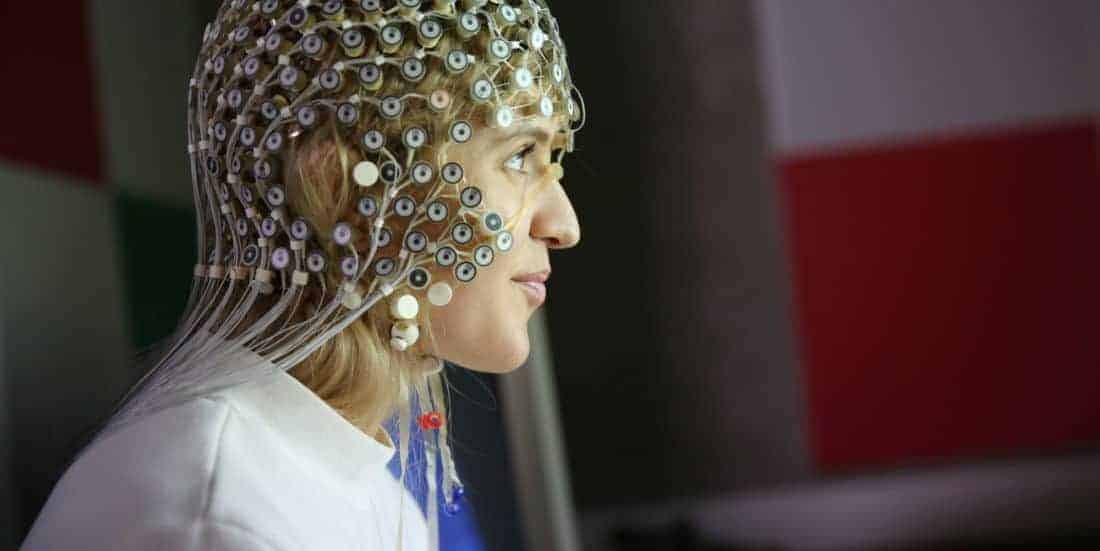
Both studies were conducted using an EEG to track and record brain wave activity. The participants wore a hood with over 250 electrodes attached.

The brain produces electrical impulses when it is active. The sensors in the electrodes are very sensitive and pick up the electrical activity that takes place in the brain.

Handwriting gives the brain more hooks to hang memories on

Why writing by hand makes kids smarter

– It is a little slower to write by hand, but it is important that children go through the tiring phase of learning it, says Professor Audrey van der Meer at NTNU. Photo: NTNU / Microsoft

Each examination took 45 minutes per person, and the researchers received 500 data points per second.

The results showed that the brain in both young adults and children is much more active when writing by hand than when typing on a keyboard.

“The use of pen and paper gives the brain more ‘hooks’ to hang your memories on. Writing by hand creates much more activity in the sensorimotor parts of the brain. A lot of senses are activated by pressing the pen on paper, seeing the letters you write and hearing the sound you make while writing. These sense experiences create contact between different parts of the brain and open the brain up for learning. We both learn better and remember better,” says Van der Meer.

Digital reality a big part of European children’s lives

She believes that her own and others’ studies emphasize the importance of children being challenged to draw and write at an early age, especially at school.

Today’s digital reality is that typing, tapping and screen time  are a big part of children’s and adolescents’ everyday lives.

A survey of 19 countries in the EU shows that Norwegian children and teens spend the most time online. The smartphone is a constant companion, followed closely by PCs and tablets.

The survey shows that Norwegian children ages 9 to16 spend almost four hours online every day, double the amount since 2010.

Kids’ leisure time spent in front of a screen is now amplified by schools’ increasing emphasis on digital learning.

Van der Meer thinks digital learning has many positive aspects, but urges handwriting training.

National guidelines needed

Why writing by hand makes kids smarter

tapping, viewing and typing. A survey shows that Norwegian children in the age group 9-16 years spend almost four hours online every day. This is a doubling since 2010. Photo: Colourbox

“Given the development of the last several years, we risk having one or more generations lose the ability to write by hand. Our research and that of others show that this would be a very unfortunate consequence” of increased digital activity, says Meer.

She believes that national guidelines should be put in place that ensure children receive at least a minimum of handwriting training.

“Some schools in Norway have become completely digital and skip handwriting training altogether. Finnish schools are even more digitized than in Norway. Very few schools offer any handwriting training at all,” says Van der Meer.

In the debate about handwriting or keyboard use in school, some teachers believe that keyboards create less frustration for children. They point out that children can write longer texts earlier, and are more motivated to write because they experience greater mastery with a keyboard.

Important to be outside in all kinds of weather

“Learning to write by hand is a bit slower process, but it’s important for children to go through the tiring phase of learning to write by hand. The intricate hand movements and the shaping of letters are beneficial in several ways. If you use a keyboard, you use the same movement for each letter. Writing by hand requires control of your fine motor skills and senses. It’s important to put the brain in a learning state as often as possible. I would use a keyboard to write an essay, but I’d take notes by hand during a lecture,” says Van der Meer.

Why writing by hand makes kids smarter

To develop the brain as best we can, we must live the real life, not the life behind a screen. That is the opinion of Professor Audrey van der Meer at NTNU. Photo: Colourbox

Writing by hand challenges the brain, as do many other experiences and activities.

“The brain has evolved over thousands of years. It has evolved to be able to take action and navigate appropriate behaviour. In order for the brain to develop in the best possible way, we need to use it for what it’s best at. We need to live an authentic life. We have to use all our senses, be outside, experience all kinds of weather and meet other people. If we don’t challenge our brain, it can’t reach its full potential. And that can impact school performance,” says Van der Meer.

ReferenceThe Importance of Cursive Handwriting Over Typewriting for Learning in the Classroom: A High-Density EEG Study of 12-Year-Old Children and Young Adults.
Eva Ose Askvik, F. R. (Ruud) van der Weel and Audrey L. H. van der Meer. Front. Psychol., 28 July 2020 | https://ift.tt/3n8vbsC


from ScienceBlog.com https://ift.tt/2SiJEE8

Young gamers not more prone to psychiatric disorders

Young gamers not more prone to psychiatric disorders

Children who show signs of addiction-like gaming are not more susceptible to mental health problems than their non-gaming peers. Some even experience less anxiety than others.


from ScienceBlog.com https://ift.tt/2HNA7TM

Carbon pollution particles found in placenta cells for the first time

Carbon pollution particles found in placenta cells for the first time

Pollution particles including carbon and metals have been found in the placentas of new mothers.

Researchers have shown that inhaled particulate matter from air pollution can move from the lungs to distant organs, and is taken up by certain cells in the human placenta, and potentially the foetus.

As part of the study, placentas from 15 consenting healthy women were donated to the study following the birth of their children at The Royal London Hospital.

Pollution exposure was determined in 13 of the women, all of whom had exposure above the annual mean WHO limit for particulate matter.

The cells in the placentas were analysed using a range of techniques including light and electron microscopy, x-rays and magnetic analyses.

Black particles that closely resembled particulate matter from pollution were found in placental cells from all 15 women and these appeared in an average of one per cent of the cells which were analysed.

These foreign particles may well react with and damage the components of a cell to cause inflammation or to interfere with normal cellular function and hamper normal development of the foetus.

DR ZABEADA ASLAM, FACULTY OF ENGINEERING AND PHYSICAL SCIENCES

The majority of particles found in the placental cells were carbon-based, but researchers also found trace amounts of metals including silica, phosphorus, calcium, iron and chromium, and more rarely, titanium, cobalt, zinc and cerium.

Analysis of these nanoparticles strongly suggests that they predominantly originated from traffic-related sources. Many of these metals are associated with fossil fuel combustion arising from fuel and oil additives, and vehicle brake-wear.

The research team included Dr Zabeada Aslam from Leeds’ School of Chemical and Process Engineering.

Dr Aslam said: “This work shows that the smallest size fraction of inhaled airborne pollution particles are able to cross from the lungs into other organs and potentially even to a foetus via the placenta.

“This is concerning because these foreign particles may well react with and damage the components of a cell to cause inflammation or to interfere with normal cellular function and hamper normal development of the foetus.”

The study, funded by Barts Charity, has been published in the journal Science of The Total Environment.

The research team has now called for further work to fully define the direct effect that pollution particles may have on the developing foetus.

Lead author Professor Jonathan Grigg from Queen Mary University of London (QMUL) said: “Our study for the first time shows that inhaled carbon particulate matter air pollution travels in the blood stream and is taken up by important cells in the placenta.

“We hope that this information will encourage policy makers to reduce road traffic emissions in this post lockdown period.”

Dr Lisa Miyashita, also from QMUL, added: “We have thought for a while that maternal inhalation could potentially result in pollution particles travelling to the placenta once inhaled.

“However, there are many defence mechanisms in the lung that prevent foreign particles from travelling elsewhere, so it was surprising to identify these particles in the placental cells from all 15 of our participants.”

Fiona Miller Smith, Chief Executive of Barts Charity said: “This is an incredibly important study and immensely relevant to mums-to-be in our local community, indeed in any urban community anywhere in the world.

“In the current climate it can be hard to see beyond COVID and so we are particularly proud to have funded this vital work and truly hope that it will lead to greater awareness of the risks of pollution to the unborn child.”

Funding to use the state-of-the-art analytical microscopy facilities in LEMAS (Leeds Electron Microscopy and Spectroscopy Centre) at the University of Leeds in order to image the small particles came through the Leeds EPSRC Nanoscience and Nanotechnology Facility (LENNF), which provides access for external users who study soft matter systems, and also the Sir Henry Royce Institute for advanced materials equipment access scheme.

The study involved researchers from the University of Leeds, University of Lancaster, Barts Health NHS Trust, University of Manchester, Central Manchester University Hospital NHS Foundation Trust, King’s College London, University of Birmingham and the University of Oxford.

Further information

Picture by Pixabay, credit Greyerbaby

The research paper Evidence for the presence of air pollution nanoparticles in placental tissue cells is published in Science of The Total Environment.

For further details, contact University of Leeds press officer Lauren Ballinger at L.ballinger@leeds.ac.uk


from ScienceBlog.com https://ift.tt/3n2JNd4

Decent living for all does not have to cost the Earth

Decent living for all does not have to cost the Earth

Global energy consumption in 2050 could be reduced to the levels of the 1960s and still provide a decent standard of living for a population three times larger, according to a new study.

The study, led by the University, has estimated the energy resource needed for everyone to be provided decent living standards in 2050 – meaning all their basic human needs such as shelter, mobility, food and hygiene are met, while also having access to modern, high quality healthcare, education and information technology.

The findings, published in in the journal Global Environmental Change, reveal that decent living standards could be provided to the entire global population of 10 billion that is expected to be reached by 2050, for less than 40% of today’s global energy. This is roughly 25% of that forecast by the International Energy Agency if current trends continue.

This level of global energy consumption is roughly the same as that during the 1960s, when the population was only three billion.

The authors emphasise that achieving this would require sweeping changes in current consumption, widespread deployment of advanced technologies, and the elimination of mass global inequalities.

However, not only do the findings show that the energy required to provide a decent living could likely be met entirely by clean sources, but it also offers a firm rebuttal to reactive claims that reducing global consumption to sustainable levels requires an end to modern comforts and a ‘return to the dark ages’.

The authors’ tongue in cheek response to the critique that sweeping energy reform would require us all to become ‘cave dwellers’ was: “Yes, perhaps, but these are rather luxurious caves with highly-efficient facilities for cooking, storing food and washing clothes; comfortable temperatures maintained throughout the year, computer networks — among other things — not to mention the larger caves providing universal healthcare and education to all 5-19 year olds.”

Our study is consistent with the long-standing arguments that the technological solutions already exist to support reducing energy consumption to a sustainable level.

DR JOEL MILLWARD-HOPKINS, SCHOOL OF EARTH AND ENVIRONMENT

The study calculated minimum final energy requirements, both direct and indirect, to provide decent living standards. Final energy is that delivered to the consumer’s door, for example, heating, electricity or the petrol that goes into a car, rather than the energy embedded in fuels themselves – much of which is lost at power stations in the case of fossil fuels.

The team built a final energy-model, which builds upon a list of basic material needs that underpin human well-being previously developed by Narasimha Rao and Jihoon Min.

The study compared current final energy consumption across 119 countries to the estimates of final energy needed for decent living and found the vast majority of countries are living in significant surplus. In countries that are today’s highest per-capita consumers, energy cuts of nearly 95% are possible while still providing decent living standards to all.

It is clearly within our grasp to provide a decent life for everyone while still protecting our climate and ecosystems.

PROFESSOR JULIA STEINBERGER, LEADER OF THE LIVING WELL WITHIN LIMITS PROJECT AT LEEDS

Study lead author Dr Joel Millward-Hopkins from the School of Earth and Environment at Leeds said: “Currently, only 17% of global final energy consumption is from non-fossil fuel sources. But that is nearly 50% of what we estimate is needed to provide a decent standard of living for all in 2050.”

“Overall, our study is consistent with the long-standing arguments that the technological solutions already exist to support reducing energy consumption to a sustainable level. What we add is that the material sacrifices needed to for these reductions are far smaller than many popular narratives imply.”

Study co-author Professor Julia Steinberger leader of the Living Well Within Limits project at the University Leeds and professor at the Université de Lausanne in Switzerland said: “While government official are levelling charges that environmental activists ‘threaten our way of life’ it is worth re-examining what that way of life should entail. There has been a tendency to simplify the idea of a good life into the notion that more is better.

“It is clearly within our grasp to provide a decent life for everyone while still protecting our climate and ecosystems.”

Study co-author Professor Narasimha Rao from Yale University said: “This study also confirms our earlier findings at a global scale that eradicating poverty is not an impediment to climate stabilization, rather it’s the pursuit of unmitigated affluence across the world.”

Study co-author Yannick Oswald, PhD researcher at the School of Earth and Environment at Leeds said: “To avoid ecological collapse, it is clear that drastic and challenging societal transformations must occur at all levels, from the individual to institutional, and from supply through to demand.”

Further information:

The paper Providing “Decent Living with Minimum Energy: A Global Scenario” was published in Global Environmental Change on 29 September 2020

For additional information contact University of Leeds press officer a.harrison@leeds.ac.uk.


from ScienceBlog.com https://ift.tt/2GndOn8

Fecal transplantation can restore the gut microbiota of C-section babies

Fecal transplantation can restore the gut microbiota of C-section babies

The human gut contains a diverse ecosystem of microbes: mainly bacteria, as well as viruses and fungi, termed the gut microbiota. Recent years have shown that the gut microbiota have widespread effects on the overall functioning of the host’s body.

Normally infants receive gut bacteria from the mother at birth. Some of these maternal bacteria grow out in the infant as they aid the infant in digesting breast milk.

Birth by Cesarean section (C-section) has been shown to be especially detrimental to normal gut microbiota development. During birth by C-section infants are not exposed to maternal fecal microbes and this prevents the natural transfer of microbes from mother to baby.

In the recently reported study, researchers of mainly the University of Helsinki evaluated whether the disturbed intestinal microbiota development could be restored in term Cesarean section infants by postnatal, orally-delivered maternal fecal microbiota transplantation (FMT). FMT has been successfully used in adults to normalize gut microbiota composition and cure diseases such as recurrent Clostridium difficile infections.

The results of the study are published in the scientific journal Cell.

“Birth by C-section is associated with an increased risk of many immune-related diseases, suggesting that the lack of maternal microbes in early life may have long-term consequences on the health of the child. This proof-of-concept study demonstrates that the intestinal microbiota of infants born by C-section can be postnatally restored by maternal FMT and provides further support for the natural transfer of gut microbiota from mother to infant,” says Willem M de Vos, Professor of Human Microbiomics who was a senior author on the study.

The procedure reduces risks that abnormal gut microbiota may confer

The researchers applied FMT immediately after birth by using the infants’ own mothers’ fecal samples. Because feces can contain dangerous pathogens, these were first carefully screened. Out of 17 tested mothers, 7 had pathogen-free samples and were selected for the study.

All seven C-section born infants that received the FMT remained healthy and experienced no negative effects from the treatment. Their gut microbiota composition was monitored for 3 months and compared the composition to that of untreated C-section born infants and vaginally born infants.

“The gut microbiota of the FMT-treated infants became very quickly similar to that of vaginally born infants. It did not resemble that of the untreated C-section born infants, showing that the treatment was effective in restoring normal microbiota development,” says Dr. Katri Korpela, first author on the study.

“This simple procedure can normalize gut microbiota colonization and development in C-section born infants, which will likely contribute to reduced risk of developing chronic diseases that abnormal gut microbiota may confer,” adds Dr. Otto Helve MD, specialist in pediatric infectious diseases and shared first author of the study.

“This procedure should be only performed after careful screening of the mother for potential pathogens,” stresses Professor Sture Andersson MD, neonatologist who also was a senior author on the publication.


from ScienceBlog.com https://ift.tt/2GrVBoB

Forest darkness helps stave off effects of nitrogen pollution – but this is set to change

Forest darkness helps stave off effects of nitrogen pollution – but this is set to change

Europe’s forests are sitting on a pollution timebomb which could rewrite their ecology when it explodes, say researchers.

Delicate forest floor plants such as wood sorrel or violet, and the balance among the tree species that tower above them, are all threatened by decades of accumulated nitrogen pollution. A study has found that the darkness of the forest has subdued the effects of nitrogen. But forests are destined to let in more light in the future as trees succumb to drought and disease.

Forests cover 40% of the European Union’s land area and are expanding in some countries, mostly because of active restoration or the abandonment of agricultural land. Forests provide services such as controlling erosion and cycling water but they are also increasingly threatened by droughts and diseases such as ash dieback.

To understand how they are responding to these challenges it is vital to study the forest floor, says Professor Kris Verheyen, an ecologist at Ghent University in Belgium.

‘This herb layer is very often forgotten. Some people call it the step-over layer – you step over it to look at the trees,’ he said.

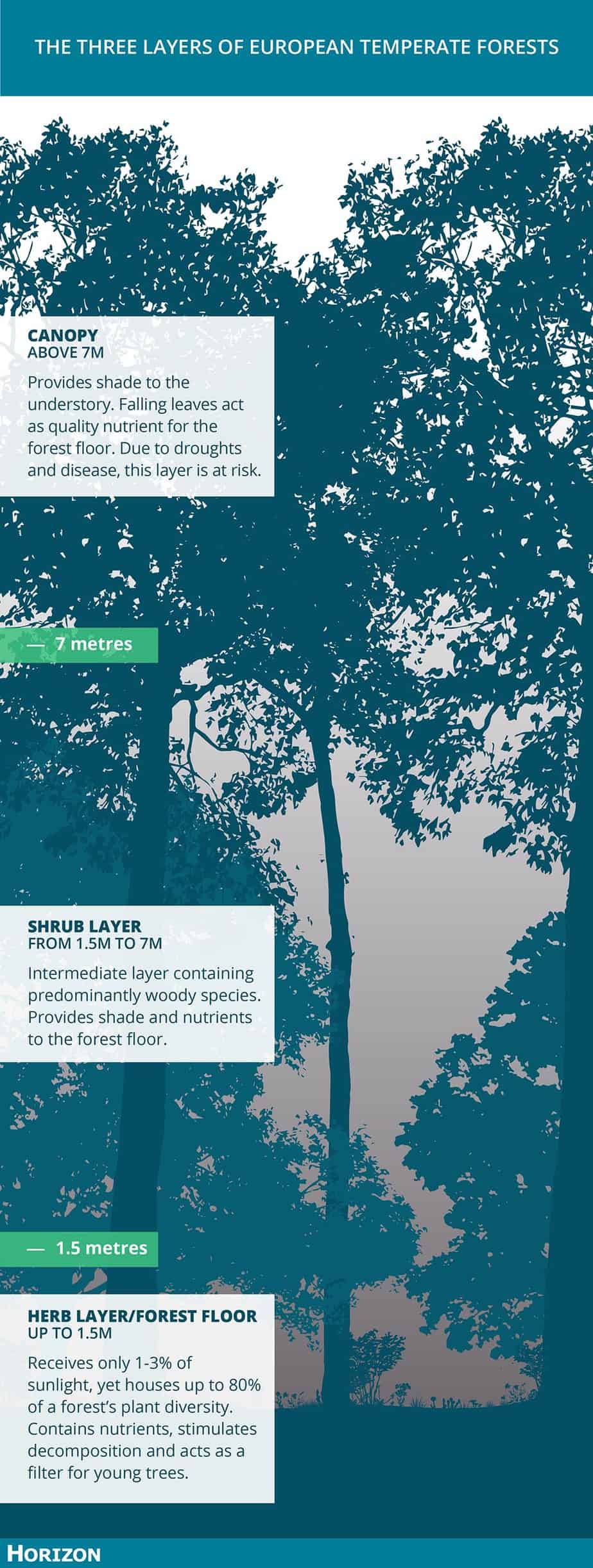
Yet, in temperate forests, the life underfoot includes 80% of a forest’s biodiversity. The herb layer cycles key nutrients such as phosphorous, potassium and nitrogen, helps decompose tree litter and filters the next generation of trees – since seedlings need to pass through it to embark on their journey to the canopy, says Prof. Verheyen.

Records

In trying to understand more about the forest floor, he led a team that retrieved records, going back in some cases as far as 50 years, of 4,000 forest plots across Europe. For those whose locations were easily identified, the researchers visited to make updated measurements.

The team also carted forest soils from around the continent to their research station where they incorporated them into outdoor experimental environments, called mesocosms, in which they varied the plants’ access to nitrogen, temperature and light.

‘The basic question we wanted to answer was how do multiple global change drivers determine the trajectories of change over time,’ says Prof. Verheyen, who led the project, known as PASTFORWARD.

Overall, the team found that the key controlling factor in forest life was light, which acts as a bottleneck preventing other changes from exerting an effect.

‘This herb layer is very often forgotten. Some people call it the step-over layer – you step over it to look at the trees.’

Prof. Kris Verheyen, Ghent University, Belgium

Nitrogen pollution

One powerful example of this was the way it has held back the effects of nitrogen pollution.

Nitrogen deposition is a chronic problem caused by ammonia emissions from agricultural fertiliser and the creation of nitrogen oxides as a by-product of burning fossil fuels. It draws certain nutrients out of soils, acidifies land, and causes algae to grow in waterways.

The researchers found plenty of nitrogen deposition in forests and documented its consequences for species. But ‘the effects are not as strong as we expected because … the nitrogen is available but the plants (on the forest floor) can’t really benefit because they are limited by the amount of light that is available,’ said Prof. Verheyen.

Some plants – types that tend to be widespread and can survive in a variety of environments including non-native species – have the machinery to take advantage of an excess of nitrogen and grow more; others – which tend to be specialists with small ranges – do not. In shaded forests they are on an equal footing. But as soon as the canopy opens up and light pours in, those that can exploit the nitrogen pollution have an advantage.

As a result, European forests are already losing their more specialist species and thus experiencing a drop in biodiversity. Prof. Verheyen is concerned that forest canopies are in danger of opening up as trees die from drought and disease which may open the floodgates to nitrogen.

‘That will lead to rapid and very large changes in the herb layer,’ he said.

Drought – itself a result of climate change – has had a ‘massive’ effect killing trees in spruce forests in Germany, Belgium and France in recent years although broadleaf forests have been more resistant for now.

This does not mean that broadleaf forests are free from canopy-opening – one example is ash dieback disease. ‘We do have evidence that because of the dying off of the ash you get a lot of light and then the understorey really explodes because light is no longer a limiting resource,’ said Prof. Verheyen.

‘These large and probably abrupt changes that may happen in the herb layer will affect the tree regeneration and will certainly determine which species will be able to pass the herb layer filter and which not. It will have its consequences for nutrient cycling because this herb layer really impacts rate of decomposition.’

Forest darkness helps stave off effects of nitrogen pollution – but this is set to change
Forest dieback can open up protective canopies. When more light is let in, forests can succumb to drought and disease. Image credit – High Contrast/Wikimedia, licenced under CC BY 3.0 DE

Buffering

The researchers also discovered that forests have so far done a remarkable job of buffering plants against the broader climate change going on outside them.

Temperature measurements revealed that forests often have significantly different temperatures from what weather stations – always placed far from trees – record. In summer, for example, they are on average 4°C cooler. This is not only because thick canopies keep out the light, but also because evapotranspiration of water through the leaves and into the atmosphere sucks heat out of the forest, and the vegetation keeps out breezes that would mix warm air into the cool.

Climate models don’t take into account this buffering, despite the fact that two thirds of the world’s species live in forests and forest processes such as carbon and nutrient cycling depend on temperature, says Professor Pieter de Frenne, a bioscientist also at Ghent University, who is leading the parallel FORMICA project investigating forest microclimates.

This, in turn, explains why, in intact forest, there has been less ‘reshuffling’ of forest species than was predicted as Europe warms, he says – forest-buffering has allowed many species to cling on.

‘We would have expected that forest plants would have responded already to a stronger degree – so that more warm-adapted species would have come into the community and more cold affinity species would have declined or even become locally extinct.’

But the effect can’t last forever and if the canopy is opened up these species will have a rude awakening as their world warms up to the temperature outside the forest.

‘Buffering is buying us time so species get a chance to adapt to the new climate,’ he said.

The work has practical implications for the way forests are managed and the PASTFORWARD and FORMICA teams are now hoping to develop a tool to help forest managers work out how much of the canopy they can remove – for example for harvesting or as part of the cycle of tree-thinning known as coppicing – without triggering this explosive growth.

Forest darkness helps stave off effects of nitrogen pollution – but this is set to change
Some experts consider there to be seven layers in a forest, while Prof. Verheyen’s team have based their work on three interconnected layers. Image credit – Horizon

The research in this article was funded by the EU. If you liked this article, please consider sharing it on social media. 

Published by Horizon


from ScienceBlog.com https://ift.tt/2Sevgg6

47th Edition of World Science Awards 2026: Celebrating Global Excellence in Research and Innovation

  47th Edition of World Science Awards 2026: Celebrating Global Excellence in Research and Innovation The 47th Edition of the World Science...